Lemmygrad’s resident expert on fascism’ — GrainEater, 2024

The political desperadoes and ignoramuses, who say they would “Rather be Dead than Red”, should be told that no one will stop them from committing suicide, but they have no right to provoke a third world war.’ — Morris Kominsky, 1970

  • 22 posts
  • 2 comments
Joined 7 years ago
Cake day: August 27th, 2019

(This takes 5–7¼ minutes to read.)

On 8 July, Ministerial Counsellor Xaver Dorsch, head of the central office of the Organisation Todt construction agency, visited Dulag 127 in Drosdy near Minsk. It was subordinated to the 286th Security Division. The transit camp had been set up in an open field on the Svisloch River; there were no buildings.¹¹ Two days after his visit, Dorsch reported on what he had seen in a letter to soon-to-be Reich Minister for the Occupied Eastern Territories Alfred Rosenberg:

The prisoner camp in Minsk accommodates in an area roughly the size of Wilhelmplatz around 100,000 prisoners of war and 40,000 civilian prisoners. Squeezed into this confined space, the prisoners can hardly move and are forced to relieve themselves where they stand. […] The prisoners of war, for whom the food problem cannot be solved, have gone in some cases six to eight days without food and know only one obsession in their state of bestial apathy brought on by starvation: to find something edible. […] During the night, the starving civilians fall upon those with supplies and beat each other to death to obtain a piece of bread. The only possible language of the weak guard detachment, which carries out its duty day and night without being relieved, is firearms, of which it ruthlessly avails itself.¹²

Despite the extreme heat, some of the [Axis] guards forbade the prisoners to drink from the river; hundreds were shot while attempting to do so.¹³

In the first two months of the war, despite their drastic undernourishment, most Soviet prisoners still possessed a remnant of physical resilience, and weather conditions were favorable.

Around this time, however, the first hunger-related epidemics broke out. Already in September 1941, death rates increased considerably. During that month, between 5,000 and 9,000 Soviet prisoners died in Army Group Centre’s rear area alone, and 9,000 in the POW camps of the Government General. In Stalag 342 (Molodechno) in General Commissariat Belarus, 200 prisoners a day were dying with a terrible constancy — around 6,000 per month in a single camp. There, prisoners tormented by hunger even requested the Wehrmacht guards in writing to end their suffering by shooting them.¹⁴

Cases of cannibalism occurred in the Molodechno camp in early September and in Borisov no later than the end of the month. Cannibalism is also documented in other camps in Belarus, namely those in Bobruisk, Mogilev, Minsk, and Glubokoye.¹⁵

Instances of cannibalism were likewise reported for the camp in Shepetovka and a transit camp in the vicinity of Krivoy Rog, both in Ukraine, in late September and October 1941, respectively.¹⁶ In all POW camps, the [Axis] authorities imposed the death penalty for cannibalism.¹⁷

In Adabash, a branch camp of Stalag 305 in Kirovograd, Ukraine, the camp authorities even had six offenders pose for photographs with the remains of the corpse they had disemboweled and partially eaten, before having them shot.¹⁸

[…]

From October 1941, mass mortality in all Wehrmacht camps holding Soviet POWs assumed monstrous proportions: in October, November, and December, between 300,000 and 500,000 prisoners died each month; in January 1942, it was 155,000; in February, 80,000; and in March, 85,000. During November 1941, 83,000 prisoners died in the Government General alone: 38.2 percent of the prisoners present at the start of the month. In the rear area of Army Group Centre, the death toll for November came to around 80,000.³²

During a discussion in Berlin in late November 1941, Göring informed the Italian foreign minister, Count Galeazzo Ciano, of conditions in the POW camps (including cases of cannibalism) and disparagingly compared the Soviet prisoners to ‘a herd of ravenous animals’ (una mandria di animali famelici).³³

The clearest and most direct instruction for the murder of a substantial share of the Soviet POWs was issued by Quartermaster General Wagner during a meeting of the chiefs of staff of all armies and army groups deployed on the Eastern Front with the chief of the Army General Staff, Franz Halder, on 13 November in Orsha. Wagner declared unequivocally: ‘Prisoners of war in the POW camps who are not working have to starve to death.’³⁴ This was a death sentence for 55 percent of the prisoners.³⁵

A rare letter sent by a captive soldier to his family illustrates the suffering of Soviet prisoners in Kaunas’s Sixth Fort, which had been converted into a POW camp. Captured north of Novgorod on 14 September 1941, F. J. Koshedub was transferred from one camp to another before making the journey on foot from Gomel to Kaunas, ‘where a ready-made mass grave is awaiting me’. On 19 October, he wrote:

Since the first day of captivity, I’ve been starving and I expect every day to be my last. […] We are incarcerated in the Sixth Fort. […] We are sleeping in a pit under open skies. We receive 200g of bread a day, half a litre of boiled cabbage and half a litre of tea with mint. Everything is unsalted, so that we don’t swell up. With sticks and steel rods, we are driven to work, though we don’t receive any extra food. We have millions of lice. For two months, I haven’t shaved, washed or changed my clothes. I have underwear, overgarments, a military coat, a field cap and shoes with putties. It is cold, muddy and dirty. Between 200 and 300 men die every day. That is the situation I’m in, and my days are numbered. Only a miracle can save me. So farewell, my darlings; farewell, my loved ones, friends and acquaintances. If a good person can be found to pass on my letter, at least you’ll know where I met my inglorious and bitter death.³⁶

[…]

By the beginning of February 1942, that is, over the space of little more than 7 months, 2 million Soviet prisoners of war had died or been murdered in [Axis] custody. This was almost 60 percent of the 3.35 million Red Army soldiers captured during this period, most of them by the end of October 1941.⁴²

On Reich territory, at least 265,000 Soviet POWs died during these months; this constituted a death rate of around 53 percent. (By contrast, death rates among Polish and Soviet civilian forced laborers inside Germany were well below 10 percent.) The fact that this rate of mortality was scarcely lower than the death rate in the POW camps east of the Reich’s borders not only sheds an unmistakeably clear light on living conditions for captive Soviet soldiers in Germany.⁴³

It also throws into stark relief the common fate of Soviet POWs in [Axis] captivity regardless of their whereabouts and gives the lie to the claim that long transportation routes and the associated supply problems were to blame for the mass mortality. Over an extended period between October 1941 and February 1942, just as many people died in a single large POW camp in the occupied Soviet territories as could be murdered during the same time by an entire SS Einsatzgruppe.⁴⁴

Indeed, as of winter 1941/42, captured Soviet troops constituted the largest single victim group of [the Western Axis’s] mass-killing policies.

(Emphasis added. Click here if you have time for more.)

The fate of Soviet POWs during the winter of 1941/42 even prompted Reich Minister for the Occupied Eastern Territories Alfred Rosenberg, mentioned earlier, to send a letter of protest to Chief of the OKW Wilhelm Keitel at the end of February 1942:

The fate of the Soviet prisoners of war in Germany is […] a tragedy of the greatest magnitude. From 3.6 million prisoners of war, today only several hundred thousand are fully capable of working. A large proportion of them have starved or perished as a result of the adverse weather conditions. Thousands have succumbed to typhus. It is clear that feeding such masses of POWs gives rise to difficulties. All the same, […] death and ruin on the scale described could have been avoided. Within the Soviet Union, for example, the local population, according to the available information, was quite willing to provide the prisoners of war with food. What’s more, a few perceptive camp commandants have successfully taken this path.

In the majority of cases, however, the camp commandants prohibited the civilian population from giving the POWs food, and instead preferred them to starve to death. Even on the march to the camps, the civilian population was not allowed to give food to the POWs. Indeed, in many cases in which POWs could no longer go on during marches due to starvation and exhaustion, they were shot before the eyes of the horrified civilian population and their corpses left behind. In numerous camps, no shelter whatsoever was provided for the POWs. By rain and by snow, they lay under the open sky. They were not even given the tools necessary to dig burrows or holes. A systematic delousing of the POWs in the camps and of the camps themselves was evidently not carried out. Remarks were heard such as: ‘The more of these prisoners die, the better it is for us.’⁴⁵

It is clear from Rosenberg’s letter that the woefully inadequate accommodation in the camps and starvation resulting from the refusal to allow the civilian population to give prisoners food were the main causes of the mass mortality among Soviet POWs. Rosenberg was a senior party official and a member of the Nazi old guard. He was himself guilty of war crimes and crimes against humanity, for which he would be executed in Nuremberg after the war.

At the beginning of September 1941, he had expressly declared that the provisions of the 1907 Hague Convention on Land Warfare, which stipulated that prisoners of war ‘must be humanely treated’ and had been signed by Germany and Russia, were not valid in the occupied Soviet territories.⁴⁶

Even he, however, was appalled at the Wehrmacht’s inhuman treatment of captive Soviet soldiers. Rosenberg had known about what was happening in the POW camps since the first half of July 1941, when he had received a detailed report about conditions in a transit camp in Drosdy near Minsk. At the time, however, he was not willing to openly condemn this treatment.

Only at the end of February 1942, in a radically different situation following the deaths of 2 million Soviet POWs, did he support appeals made by a senior member of his staff (Dr. Otto Bräutigam, the real author of Rosenberg’s letter) for an improvement in conditions and protest.

This extermination—I hardly need remind you—was inspired principally by the brutal European colonization of Turtle Island, wherein millions of humans had to perish so as to free up room and other resources for monopolist settlers.

(This takes 4½ minutes to read.)

Wanting to prevent an encirclement of communist and socialist governments as well as needing a testing ground for the newly militarized Luftwaffe, Hitler committed the Condor Legion of bombers to aid General Franco’s Nationalist forces in Spain.

The Condor Legion served as a laboratory for Luftwaffe command, and almost every lesson learned during the Spanish Civil War informed [Luftwaffe] strategy during the coming conflicts. The culmination of the educational experience for Condor Legion commanders was the bombing of the city of Guernica. Immortalized in human consciousness by Pablo Picasso’s namesake painting, Guernica represented the beginning of prominence for terror bombing in German doctrine.

On a relatively quiet afternoon in April, countryside traders made their way into the small town in order to participate in the weekly market day. At the time, few to no soldiers resided in Guernica and as a result the war had not yet touched it. Roberts suggests that the Condor Legion’s commander selected the town for this exact reason. He would be able to measure the destruction caused by an attack accurately.⁵

Some traders were turned away by town guardsmen because the church bell rang out, signaling an incoming air raid. Unfortunately, not everyone was so lucky. After an initial attack run from a single Heinkel-111, one of which is shown in Figure 1, second and third waves of bombers caught first responders trying to help the wounded as well as destroying buildings that had not yet been damaged.⁶

A British Pathé video captured images of steaming piles of rubble in place of some buildings. Teams of men dug out survivors and moved corpses wrapped in blankets. Whole truckloads of families evacuated the city. Guernica’s civilians would not escape Fascist wrath, however, as their flight took them further into the “Iron Ring” around the Republican stronghold of Bilbao. Soon German, Italian, and Spanish Nationalist forces attacked Bilbao even more brutally.⁷

After the Heinkel medium bombers exhausted their reserves of incendiary bombs, the civilians of Guernica once again believed [that] they were safe. They ventured out to assist the dead and dying. Once again, the [Fascists] had set a trap. Dust kicked up around the Spaniards as [Fascist] fighters strafed the streets with machine guns and pilots dropped grenades on clusters of defenseless people on the ground. After the attack, in the words of one reporter who was an eyewitness to the bombing, “large parts of Guernica aren’t a shell but an ash heap.”⁸

The concept of attacking a civilian population with such unflinching ferocity was so unheard of that people around the world had difficulty accepting that such an event had even occurred. Only days after the attack, The Sun in Baltimore published a story by G.L. Steer confirming reports of a [Luftwaffe] attack on the Spanish city.⁹

Steer felt the need to strike down claims that no such attack had ever occurred. He did so by recounting his harrowing experience on the day of the attack. He spoke of being machine-gunned and detailed the planes with unmistakably [Fascist] markings attacking the city. The day after the attack, Steer went into the town to find evidence. He discovered fragments of bombs “exactly of the same metal as bombs lately used by Gen. Emilo Mola’s German planes on the front line,” which also bore the [Fascist] crest of the golden eagle.¹⁰

Some, including the mayor of Guernica, refused to believe that a planned attack with this level of viciousness could have happened. Steer provided compelling evidence that the Luftwaffe was more than capable of executing such a diabolical plan. Finally, the [Fascist] experiment in bombing for terror ended with more twisted success than Ludendorff or even the Legion’s commander, the infamous [Fascist] field marshal Hugo Sperrle, had likely hoped for.

Relatively few casualties plagued Guernica by comparison to World War Two standards, but the breach of wartime etiquette signaled much more sinister acts of war to come. The bombing of Guernica became, in Stephens’ words, “the symbolic act that defined the greater atrocity—a calculated attack on a town or city crowded with civilians,”¹¹ and this atrocity returned with the [Fascist invasion of Poland].

Military historian James Corum identified the connecting thread between the Spanish Civil War and [the rest of] World War Two, saying “the Condor Legion’s experience in breaking the Basque fortifications at Bilbao in June 1937 foreshadowed the use of massed German aircraft to destroy the Polish fortifications at Modlin in September 1939.”¹² Similarly, the same tactics used at Guernica returned time and again in civilian centers of Poland, France, the Low Countries, the Soviet Union, and Great Britain.

Lessons learned from the Condor Legion were applied in [Luftwaffe] operations training throughout the Second World War. An inferno rained from the skies over Warsaw, Rotterdam, the Champagne city of Mareuil, Paris, London, Moscow, and London once again between the years of 1939 and 1945.¹³

[…]

In May 1940, the New York Times published a column claiming that Hermann Göring, the supreme commander of the Luftwaffe, threatened retaliatory strikes against Great Britain, specifically using the word terror in its inflammatory language.²¹

Promising “mighty blows” against the British body and flexing the perceived muscle of the [Luftwaffe], Göring was laying blame for his intentional targeting of civilian populations squarely on British military operations against Germany.²²

While this was framed as a retaliation for British operations and the Blitz—an all-out aerial assault aimed primarily against civilians which lasted almost a full year—is often cited as the beginning of [the Third Reich’s] aggression towards civilian populations, that explanation is far from the truth.

It is important to remember that [Fascist] fire rained on Warsaw and other Polish cities months before the publication of this article, not to mention Guernica years before. While Göring threatened only Great Britain, the Luftwaffe went on to target Dutch and Belgian cities as well as French border towns like Mareuil with terror strikes only five months later, using the same methods that were tested at Guernica. The first sorties of the Blitz didn’t fly until early July of 1940, long after the Reichsmarschall made his threat.

[…]

From 1936 until the end of the Second World War, Göring was in charge of air force doctrine. It is highly unlikely that der totale Krieg’s doctrine was developed and tested in Spain, then implemented on an industrial scale in Poland and Western Europe, without Göring’s knowledge and support.

It is possible that he simply didn’t want to anger Hitler by committing Luftwaffe resources to other pursuits, but far more plausible that Göring himself saw merit in the terrorizing aspects of bombing noncombatant population centers. This is corroborated by Göring’s place as the very first to be named as a defendant at the Nuremberg Military Tribunal for Major War Criminals.³⁵

(Emphasis added.)

(This takes six minutes to read.)

Quoting Angelo Nicolaides’s ‘Anti-Semitic Propaganda and the Christian Church in Hitler’s Germany: A Case of Schrödinger’s Cat’:

Hitler signed a Reichskonkordat (Reich Concordat) in 1933. This was in essence an accord with the Vatican that obligated the [Third Reich] to respect the independence of Roman Catholic institutions and simultaneously barred clergy from participating in political affairs (Evans, 2005: 234–235).

The Vatican stated in its newspaper L’Osservatore Romano that the concordat should not by any means be viewed in the light of any kind of acceptance of Nazism (Carroll, 1999). It was rather aimed appeasing a régime whose leader, Adolf Hitler strove to portray himself as a Messianic character sent from G-d to save Germany.

In this regard, the leading German philosopher in Germany at this time, Martin Heidegger, who had condemned various Jewish and left wing associates in 1933, supported [Fascism] and viewed Hitler as a Nietzschean superman. He called for “synthesis between science and the power of the will, between workers and thinkers” (Eatwell, 1995: 117) in a “Third way”.

In 1933, Hermann Goering banned all Catholic newspapers in the city of Cologne, mentioning that “political” Catholicism would not be endured but eventually the ban was lifted. In February of the same year Adam Stegerwald, who was a conspicuous politician, was confronted while speaking at a public meeting orchestrated by Christian trade unions and the Catholic Centre Party, and numerous priests were hurt in the mêlée which followed (Gajewski, 1999).

Hitler as part of his Kirchenkampf (church struggle) sought to attempt to unite the forces in Germany and made a public petition for the Church to negotiate the terms of a new Concordat (Church-State covenant) as he knew the Vatican would find it difficult to decline it, as Catholics would be compromised if they did.

Pope Pius XI and his Secretary of State, Cardinal Eugenio Pacelli were thus confronted with a quandary. If they did not negotiate with Hitler, he would definitely publicise his terms and claim that the Vatican was anti-Nazi and filibustering. Pacelli opted for an agreement since he believed such an action would provide a better basis for the protection of both civil and religious rights for Catholics.

The Reichskonkordat detached the Roman Catholic Church in Germany and this was considered to be an important move in the fight against the Jewry. There was in fact very remote possibility of not agreeing with [Berlin’s] plans as thousands of Catholic Center Party campaigners were in concentration camps by the end of June 1933.

The anticipated Concordat was signed in July 1933 and indicated that various undertakings such as for example, education, youth associations and Church rallies would be guaranteed by laws in the Reich. The Church was forced to no longer support the Centre and the Bavarian People’s Parties (Gajewski, 1999).

Quoting David I. Kertzer’s The Pope and Mussolini: The Secret History of Pius XI and the Rise of Fascism in Europe, pg. 201–2:

In July, Cardinal Pacelli escorted the German vice chancellor Franz von Papen into his Vatican apartment. The concordat they signed there guaranteed the German Church the right to manage its own affairs and offered various protections for priests, religious orders, and Church property. But much of its language, particularly that dealing with Catholic associations and schools, was vague.¹³

Heinrich Brüning, the Center Party leader who had served as Germany’s chancellor from 1930 to 1932, was irate. The Vatican, he fumed, had sold out the Catholic party and cast its lot with Hitler. He blamed Cardinal Pacelli, who, he charged, misunderstood the nature of Nazism. Pacelli’s faith in the “system of concordats,” Brüning later wrote in his memoir, “led him and the Vatican to despise democracy and the parliamentary system.”¹⁴

The pope soon realized that his “pact with the devil”—as the Church historian Hubert Wolf has described it—was not going to turn out the way he hoped.¹⁵ At the same time they signed the concordat, the [German Fascists] introduced their Law for the Prevention of Hereditarily Diseased Offspring, which mandated the forced sterilization of those deemed defective—in clear contrast with Church doctrine.

Hitler also began moving against the Church’s dense network of parochial schools. The [German Fascists] wanted a church [that] they could fully control. In early fall the Vatican secretary of state office produced an alarming analysis of these efforts; it included the text of a song popular in the Hitler Youth, calling Hitler their “redeemer.”¹⁶

In October the editor of Italy’s most prominent Catholic newspaper, L’Avvenire d’Italia, warned that the [German Fascists] were working toward “a German national church in which Protestants and Catholics are to be mixed together.”¹⁷ In December, in his annual Christmas address to the cardinals, Pius XI voiced his disappointment with the [Third Reich’s] government. Pacelli and von Papen had signed the concordat only five months earlier.¹⁸

While the pope’s doubts about Hitler were growing, those closest to him were trying to keep relations as harmonious as possible. In early 1934 both Cardinal Pacelli and the papal nuncio in Germany, Monsignor Cesare Orsenigo, cautioned the pope against saying anything that would anger Hitler, lest it further undermine the Church’s position.¹⁹

In Berlin, Orsenigo had help in his efforts, having retained Pacelli’s personal assistant from his time as nuncio, the German Father Eduard Gehrmann. As one Vatican observer put it, Father Gehrmann “believed more in Hitler than in Christ.”²⁰

The fact that Pius XI chose Cesare Orsenigo as nuncio to [the Third Reich] reveals much about the pope. Other than the nuncio to Italy, there was no more crucial, or complex, diplomatic assignment in the Vatican, yet Orsenigo was a man of limited intelligence and even more limited worldview.

Pg. 207:

In July 1933, when Dollfuss had learned that the Vatican was about to sign a concordat with Hitler, he became angry, convinced it would undermine Austrian resistance to a [German Fascist] takeover.

Knowing that Dollfuss had written a document expressing this view, Pacelli asked the Austrian ambassador to the Holy See for a favor. It would be good, said Pacelli, if Dollfuss’s account could be removed from the Austrian diplomatic archives.⁴⁰

In a pitiful attempt to exonerate the Pope, John Rodden & John P. Rossi authored a piece titled ‘Was Pius XII “Hitler’s Pope”? The Concordat of 1933’ in 2014. The complete absence of formal citations makes their research look amateurish at best, and some assertions are downright laughworthy, like German Fascism being a ‘new menace to Western civilization.’ Other assumptions are plausible, like the Vatican struggling to maintain its power and influence in an increasingly secularised world, and it is undeniable that all ‘neutral’ régimes (Vatican City included) during the Fascist era had to put on a balancing act to avoid being excessively friendly with and dependent on the Third Reich. Yet it is precisely the concessions that make their exculpatory piece so unimpressive. For example:

Pacelli also believed that German and Italian fascism could function as an effective bulwark against Marxism-Leninism. Most [pseudo]democracies harbored similar views about the choice between fascism and Communism. Hitler ingeniously exploited this belief in the years leading up to World War II, and the appeasement policy of European governments owed much to a perception of Hitler’s non-negotiable anti-Communism.

[…]

Nonetheless, it is unhistorical and one-sided to hold the Vatican and Pius XII guilty of inaction regarding [German Fascism] when they did speak out by 1937 against the evils of racism and rampant nationalism. Vituperations against the Vatican because it did not take a stronger stand against [German Fascism], did not expressly condemn the Reich, or didn’t excommunicate Hitler: the shrill denunciations amount to ex post facto thinking.

One may contend that a clear condemnation of [German Fascism] was part of the church’s duty as a teacher on faith and morals. And yet, just as plausibly, one can argue that saving lives by not provoking a monomaniacal dictator like Hitler was more judicious than delivering a grand moral gesture.

(All emphasis added.)

Nearly every anticommunist apologist will tell you that the world’s liberal régimes, and even ultranationalist ones, had no choice but to appease the Third Reich, lest they invoke its wrath. Apparently, all of these régimes that agreed on this one principle never thought to form an alliance for containing the Third Reich. Funnily enough, the Soviet Union did think of it, yet London and Paris rejected Moscow’s offer. The notion that liberal collaboration with the Fascists was always a matter of self-defence is even harder to believe in cases like Switzerland and North America, both of which would have been very difficult to successfully invade because of geography, but I’m rambling.

In any case, given that Vatican City officially received its independence in 1929 thanks to Fascist Italy, and it would be difficult to argue that the Vatican’s pre-1960s relations with Jewish communities was ‘good’, the Reichskonkordat should be unsurprising.

(This takes four minutes to read.)

With reunification in the 1860s the bourgeois state proceeded to standarize the Italian language and impose it where it had previously been rare. For example, the predominant languages in Aosta Valley had long been French and to a less extent Arpitan, but in the 1880s the state introduced Italian in tribunal and other official documents and Italian grew in further influence with the introduction of railways and industrialisation in general, slowly turning Italian into the common language among Aosta’s lower classes.

However, the Fascist state of the 1920s began an aggressive campaign to eliminate all ‘foreign’ languages and dialects in national territory despite the objections of thousands. In 1923 the bourgeois state declared the suppression of certain schools and prohibited education of students in any language other than Italian. The state forcibly converted dozens of French toponyms into Italian ones.

Even languages closely related to Italian (often called ‘dialects’), such as Emilian, Friulan, Ladin, Lombard, Ligurian, Neapolitan, Piedmontese, Romagnolo, Sardinian, Sicilian, Venetian and elsewhat, were all suppressed. The one notable exception to this homogenization was the promotion of Latin, which witnessed a new age of poetry, literature, journalism, inscriptions, prose competitions, and vocabulary, frequently with Fascist themes, as a result both of state and extrastate actors.

Sardinian culture in particular had only continued to decline in the 1860s and later, but the process of forced Italianization had only intensified during Fascism; the bourgeois state repressed local cultural expressions, including Sardinian mask festivals and improvised poetry competitions, and a large number of Sardinian surnames were forcibly ‘Italianized’.

After an argument between the Sardinian poet Antioco Casula and the fascist journalist Gino Anchisi, who claimed that ‘once the region is moribund or dead, so will the dialect [sic]’, the Fascists managed to prohibit Sardinian from the printing press as well. Antioco Casula tied the significance of Sardinian to the practices of cultural resistance of an indigenous ethnic group, whose linguistic repertoire had to be introduced in school to regain a lost dignity.

Another famed poet from Sardinia, Salvatore (Bore) Poddighe, fell into a severe depression and took his own life a few years after Cagliari’s police commissioner seized his masterwork (Sa Mundana Cummedia). When the bourgeois state officially prohibited the use of Sardinian in schools as part of its 1934 national educational plan against the alloglot ‘dialects’, the then Sardinian-speaking children were confronted with another means of communication that was supposed to be their own from then onwards too.

Overall, this period in Sardinian history was the most aggressive cultural assimilation effort by the dictatorship of the bourgeoisie, which led to an even further sociolinguistic degradation of Sardinian. A minor exception to the repression was the Sardinian Anthem of the once Piedmontese Kingdom: being a royal tradition granted it immunity to prohibition.

The suppression of non-Italic languages was no better. After Austro-Hungary’s dissolution in the late 1910s, the Kingdom of Italy also annexed Austrian Littoral and proceeded to shut down hundreds of Slavic organizations, including cultural, educational, sporting, youth, social, professional, literary, political, journalist, co-operative, and financial ones, and specifically so with the Law on Associations in 1925, the Law on Public Demonstrations in 1926, and the Law on Public Order in the same year.

Since April 13, 1920, the Fascists instigated riots against Triestine Slovenes, said to be retaliations for the assault that a Croatian population perpetrated against Italian troops occupying its territory in Split. Fascists destroyed numerous Slovene-owned shops and other buildings, culminating in one particular arson, directed by Francesco Giunta, against the Narodni dom or community hall for Triestine Slovenes. Benito Mussolini praised this action as a ‘masterpiece of the Triestine fascism’, and in September 1920 he said:

When dealing with such a race as Slavic — inferior and barbaric — we must not pursue the carrot, but the stick policy. We should not be afraid of new victims. The Italian border should run across the Brenner Pass, Monte Nevoso and the Dinaric Alps. I would say we can easily sacrifice 500,000 barbaric Slavs for 50,000 Italians.

This reflected a common Fascist opinion against the Croatian and Slovene minorities in the Julian March. After March 1923, the dictatorship of the bourgeoisie officially prohibited these languages in administration, and after October 1925 in law courts as well. In 1923, in the context of the school reform prepared by the anticommunist Giovanni Gentile, teaching in languages other than Italian was disallowed (although the Istro-Rumanian language in Šušnjevica was a minor exception). Some five hundred Slovene teachers, nearly half of all the Slovene teachers in the Littoral region, were moved by the Fascists to the interior of Italy, while Italian teachers were sent to teach Slovene children Italian.

You undoubtedly noticed that this topic was less straightforward than usual, consisting of my own research rather than lengthy quotes from a book or thesis. Well, that is because English-speaking authors do not have a lot to say about this particular feature from Fascist history. The best that I could find was this brief observation by Katie Galioto:

Similarly, minority languages were banned, gradually at first — as to not offend Italy’s powerful neighbors — and completely by the second decade of Italian Fascism (Tosi 7).

In regions bordering other states, the government made an effort to stamp out German, Croatian, and Slovene from schools and public offices. People were forced to change their last names and replace them with something more Italian — in some cases, people had to adjust inscriptions on tombstones.

However, as happened with the dialect, this push was met with resistance. In some areas, citizens opened secret private schools. Others simply refused to learn more Italian than was required to get by (Ruzza 174).

As you can see, this description is exceedingly basic: there is no sense of scale concerning the consequences of Fascist Italy’s monolingual policy, and hardly any exploration of how far-reaching it was. Someday someone is going to publish a book or thesis in English concerning the Fascists’ monolingual enforcement, but for now this is the best that I can offer.

(This takes 5¾ minutes to read.)

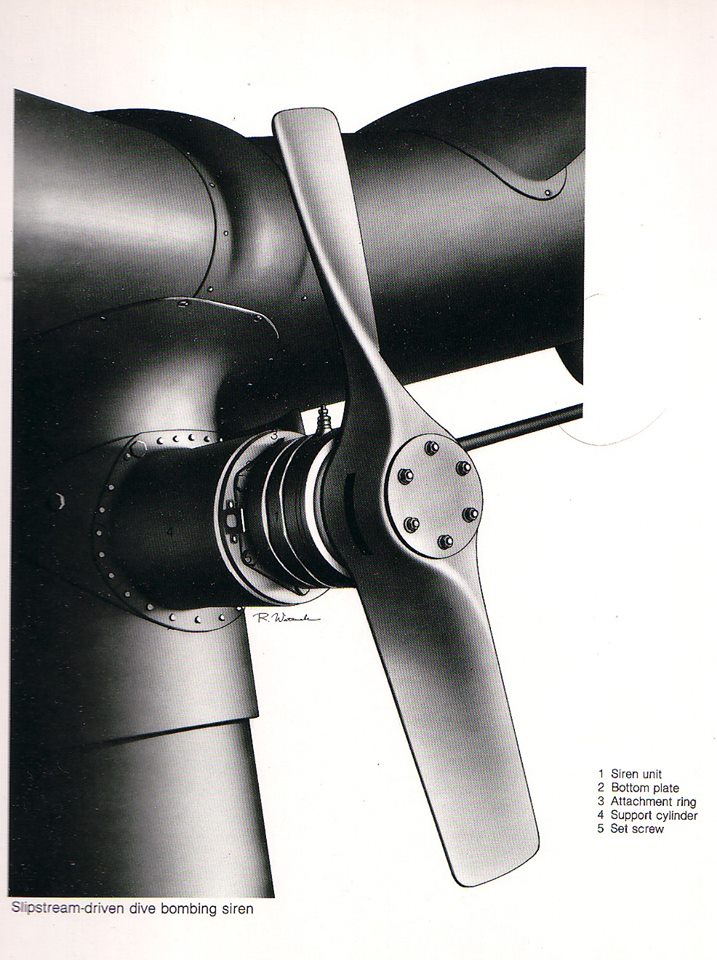
The Lärmgerät, or the so-called ‘Jericho trumpet’, is the most recognisable sound from the Second Thirty Years’ War. It is not a byproduct of sheer airplane turbulence, but an actual siren. The media tend to incorrectly associate this sound with any aeroplane that is about to crash-land. The more circumspect media correctly restrict it to the Junkers Ju 87 but tend to inaccurately suggest that it was in use throughout all of World War II, when hearing it in 1942–1945 would have been highly unlikely at best.

Quoting one website:

The B-1 was also fitted with ‘Jericho trumpets’, essentially propeller-driven sirens with a diameter of 0.7 m (2.3 ft)[42] mounted on the wing’s leading edge directly forward of the landing gear, or on the front edge of the fixed main gear fairing. This was used to weaken enemy morale and enhance the intimidation of dive-bombing. After the enemy became used to it they were withdrawn. The devices caused a loss of 20–25 km/h (10–20 mph) through drag. Instead, some bombs were fitted with whistles on the fin to produce the noise after release.[43] The trumpets were a suggestion from Generaloberst Ernst Udet (but some authors say the idea originated from Adolf Hitler).[44]

Quoting Yaron Jean’s Hearing Experiences in Germany, 1914–1945: Noises of Modernity, page 215:

Udet, drawing on his vast experience as a pilot in attacking ground targets during the First World War, hoped that these sirens—which could be activated from the cockpit while the plane was making an almost vertical dive toward its target—would prove to be a weapon of exceptional psycho-acoustic effectiveness that would instill fear in its targets and paralyze any resistance on their part. The Stuka’s siren, which used technology to associate the historical symbolism inherent in noise with the aural symbolism of approaching destruction, was given by Udet the symbolic and picturesque name “trumpet of Jericho.”⁵⁷

This was his way of pointing up the historical and symbolic relationship that had existed since primordial times between the overwhelming power of noise and how it was heard in the biblical story, and its modern incarnation in the technologies of the air war. Small wooden propellers mounted on the plane’s wings were spun by the flow of air as it dove, and this produced a bloodcurdling scream, which became for many people one of the acoustical traumas of the Second World War. As one Stuka pilot wrote home, “It must be awful to be underneath it during a dive. Only the Russian soldiers could stand it more than a few times.”⁵⁸

Quoting Brandon Grosch’s ‘The Use of Terror as a Weapon by the Luftwaffe, 1937–1945’:

Lessons learned from the Condor Legion were applied in [Luftwaffe] operations training throughout the Second World War. An inferno rained from the skies over Warsaw, Rotterdam, the Champagne city of Mareuil, Paris, London, Moscow, and London once again between the years of 1939 and 1945.¹³

For most of this period, the sounds of the Junkers Ju-87 Stuka represented the haunting impact of [Luftwaffe] terror bombing. First, the low drone of dozens of piston engines pierced through the peace of a sunny, cloudless day. Next, as the silhouettes of their inverted-gull wings filled the sky over a target city, they suddenly turned and literally screamed into action.

As the dive bombers pushed their noses down into an almost ninety-degree angle, civilians on the ground heard an air-driven siren that started at a low rumble and slowly escalated into an unholy screech followed by earth-shaking explosions as whistling bombs impacted buildings and streets populated by civilians who could not get themselves to shelter in time.¹⁴

The siren, combined with deceptively simplistic cardboard fins attached to the bombshells which created the descending whistle sound popularly associated with all bombs, announced destruction falling terminally towards helpless targets on the ground.

These features, together referred to interchangeably as the “Trumpets of Jericho” by German aircrews, were so iconic that almost every [A]llied propaganda film from the era featured their harpy-like auditory assaults whenever showing a [Luftwaffe] aircraft, regardless of whether or not the plane was actually a Stuka.

The Stuka did not always scream during its hunt, however. The beginning of the Stuka’s technical history does not indicate an operational bias towards terror. Junkers Flugzeug- und Motorenwerke AG (JFM), the production company responsible for the Stuka and other [Axis] bombers, wrote operational manuals, called Betriebsanleitungen, for its aircraft. These users’ manuals were much like those a car company would produce today. The manual for the early-war model of the Stuka, the B-1, featured many diagrams of the aircraft and its various subsections, such as figure 2, informing its pilots and mechanics about the important systems equipped on the aircraft and recommendations on how to get the best performance from the machine in flight.¹⁵

The most important detail, however, was missing from the manual. None of those plans show the siren. No portion of the passages on the Rumpfwerk (fuselage) or Fahrwerk (undercarriage), where the siren was mounted on the Stuka, mentioned the noisemaker itself.¹⁶ A Critical Past video also shows a Stuka attack on a Polish target in 1939. It too features no siren sound.¹⁷

William Green, a late-20th century military aviation historian, documents in an albeit slightly outdated but nevertheless comprehensive reference, the various versions of the Stuka. His diagrams feature the siren on the aircraft and a short description identifying its only purpose as to spread terror among those on the targeted grounds.¹⁸

This thread is common among historians who study the Stuka. No purpose existed for the siren apart from striking fear into the hearts of its targets. In fact, it created additional drag on the airframe, meaning the plane itself performed more poorly with the siren than without. Despite this, the Luftwaffe retained its use until the Stuka’s obsolescence in the mid-war, although the plane itself was never fully retired until the war’s end.

In one Frenchman’s memoir of the war, this view is corroborated as he explicitly cites the Stuka in an attack on his region. In the words of Elie Poulard,

on the morning of Sunday, May 19, it was our turn. I was getting ready to go to Mass when Stukas arrived above Mareuil… these planes were equipped with a siren and their bombs with whistles. All that made such a terrifying noise that it led to some panic in part of the village’s population… The same day, around two o’clock in the afternoon, a new wave of Stukas bombed the whole length of Mareuil.¹⁹

Poulard experienced firsthand the screeching nightmares that were the “Trumpets of Jericho,” shown mounted on some Stukas in figure 3, and he specifically experienced them while never being anywhere near the frontline of combat throughout the war.²⁰

Poulard never served as a soldier. He only mentioned the Stuka at the beginning of the war when he lived as a civilian in a small town with slight industrial capacity. Mareuil could not have been a truly military target for the Luftwaffe. Poulard, his family, and the other French civilians surviving there at the time were the intended casualties of these attacks.

These varied sources from slightly different periods of the war suggest that the siren and whistle combination was not originally included in the design, nor was it implemented on the factory line by Junkers. I find it much more plausible that the “Trumpets of Jericho” were an innovation of the field rather than of the designer’s office and were implemented by dive-bombing Stukageschwader units on an individual basis, probably at the behest of senior Luftwaffe commanders. Nonetheless, popular perspective remembers the Ju-87 as the most iconic weapon of terror in military history despite only about six years of service in the air.

(All emphasis added. Click here for more.)

There is a rumour that the siren’s purpose was more practical:

A former Stuka pilot once told another story:
those sirens where installed for the early pilots to monitor the dive speeds. Constantly looking through your sight makes you unable to read your instruments, thus frequently leading to fatal overspeed situations. This mechanic was soon regarded inefficient but kept nevertheless after one realized how much of a psychological effect it had for ground troops - both own and enemy.

Nevertheless, I have been unable to corroborate this rumor. Perhaps there is some German literature confirming it, but I cannot read German (yet).

These sirens were in use from 1939 to 1941, and were present in the early phase of Operation Barbarossa. However, Axis pilots apparently found this siren too cumbersome; it slowed down their Stukas and spoiled any surprise for the enemy, so they phased it out.

Our enemies have long used noise as a means of breaking our nerves. For byspel, many Confederates had a ‘rebel yell’ that they expressed to intimidate Unionists. More recently, Palestinians have to put up with the unnerving sound of drones hovering above them, and the settlers have repeatedly used recordings of agony to confuse Palestinians into thinking that there are others outside who need their help, drawing them into deadly traps. Do not underestimate the power of noise in warfare.

A teen employee of the Chicago Police Department resigned under fire after they wore a Nazi uniform at their high school and “goose-stepped” across the stage while performing a “Sieg Heil” salute, according to a report released Wednesday by the city’s watchdog.

“The uniform, march and salute created the impression that the individual was evoking Nazi Germany,” bringing discredit to the police department, according to the first quarterly report released by Inspector General David Glockner.

Another member of CPD was fired after showing other employees of the police department photos of the teen dressed in the Nazi uniform while at work, creating “an offensive work environment,” according to the inspector general’s report.

That member also made a false statement during their investigation with the inspector general, according to the report.

Neither former CPD member were identified in the report, in keeping with the city’s rules. Both will be placed on the city’s ineligible for rehiring list, according to the report.

In addition, a senior CPD employee failed to appropriately report the misconduct as reported by CPD policy, according to the report. That employee was reprimanded, according to the report.

While CPD policy requires all officers to be at least 21, the department’s cadet program employs teens interested in preparing for a law enforcement career. CPD also offers a paid training academy for high school juniors and seniors.

The inspector general’s report did not identify when or where the incident occurred.

However, in November 2022, a student at Jones College Prep High School wore a Nazi uniform to a Halloween costume contest, triggering protests and the removal of the school’s principal. Paul Joseph Powers stepped down as the school’s leader several months after the incident.

Former Chicago Public Schools CEO Pedro Martinez denounced the act as “antisemitic” and inconsistent with the school district’s values.

A spokesperson for CPD did not respond to a request for comment from WTTW News about the inspector general’s findings.

In May, the Chicago City Council voted to rid CPD of officers with ties to hate groups and far-right extremist organizations.

(This takes 6⅔–8⅓ minutes to read.)

Quoting Thomas Weber’s Hitler’s First War, pages 92–6:

Hitler, however, claimed that his job was not just very dangerous but that it was more dangerous than any other assignment in his regiment. In early December 1914, Hitler had already written to Joseph Popp of his post as regimental dispatch runner: ‘Ever since [being appointed dispatch runner], I have, so to speak, been risking my life every day, looking death straight in the eye.’ From that, Hitler concluded: ‘It is a sheer miracle that I am hale and hearty.’⁶

In February, he had written to his Munich acquaintance telling him that his assignment as dispatch runner for regimental HQ was ‘slightly less dirty work but all the more dangerous’.⁷

Hitler was already an incorrigible embellisher of his own war service. For instance, in January 1915, he wrote to his Munich landlord of the German capture of Messines in 1st Ypres:

First we stormed the place. The English put up a desperate defence. Only when our heavy artillery opened up and our 21-cm mortars produced craters, each large enough for a hay-cart to turn round in without difficulty, and only when the whole village with its great monastery went up in flames, did our regiments manage to take it amidst streams of blood.⁸

Hitler’s job in the war was all the more dangerous, as [Fascist] school textbooks and other propaganda accounts would recount, because he had to take messages through machine-gun fire from trench to trench, while ordinary front-line soldiers could find some protection from enemy fire inside the trenches. For instance, the 1935 children’s book Die Geschichte von Adolf Hitler den Deutschen Kindern Erzählt (The Story of Adolf Hitler Told for Children) gives an account of young Hitler constantly fighting his way through collapsing trenches, infantry fire, and exploding shells,⁹ concluding:

Hitler was always one of the bravest soldiers in every battle. His comrades at that time later said that they often marvelled that Hitler had not met with a bullet long ago. Because he was so brave and dependable, he was made a dispatch runner. He had to run straight through gunfire and bring news from one officer to another. This was a very dangerous job but Hitler always performed it courageously and quietly. For this, the Kaiser first gave him the Iron Cross Second Class, and after that even the Iron Cross First Class, which only the very bravest soldiers were given.¹⁰

In the same vein, Karl Lippert, the NCO in charge of the regimental dispatch runners, claimed in 1940 that during one of their missions in early 1915 Adolf Hitler, Anton Bachmann, and he himself ‘ran into […] heavy machine-gun fire’ at ‘the street intersection in Messines’.¹¹

Similarly, in 1940, Hitler’s fellow dispatch runner Heinrich Lugauer told the Nazi Party archive, which for propaganda purposes was recording testimony of Hitler’s former comrades: ‘I specifically remember his perpetual readiness for duty in the delivering of dispatches near Fromelles in early 1915. He would regularly take up the more dangerous routes for his married comrades. Actually we shook our heads often enough in disbelief that he managed to return completely unharmed, particularly during the advance on the Marne.’¹²

Ignaz Westenkirchner, one of Hitler’s other fellow dispatch runners, tried to underline how dangerous Hitler’s and his task was by pointing out: ‘Generally two of us were sent out together, each bearing the same dispatches, in case anything happened to either of us.’¹³

Meanwhile, Hans Mend, a cavalry dispatcher in the List Regiment, claimed in the introduction to his quasi-hagiographical account of Hitler’s war years, first published in 1930, that Hitler was ‘brave, fearless, outstanding’.¹⁴

Similar characterizations were provided by Balthasar Brandmayer in the 1930s when he told a heart-warming story about how Hitler volunteered to take over his job for two weeks in addition to his own, so that Brandmayer could visit his family in Germany.¹⁵

Similarly, Max Amann, the Staff Sergeant of regimental HQ, told U.S. interrogators in May 1945: ‘Hitler was courageous and stood up well under strain; even then he showed a passion for war.’¹⁶

[…]

The reality of Hitler’s war existence was rather different. Private Hitler had to alternate between three day shifts at the advance post of regimental HQ inside Fromelles Castle and three day shifts at the regular regimental headquarters in Fournes, where the administrative support of the regiment was based.²⁵

Fournes lay an hour’s walk from Fromelles behind the front. Even though British and French artillery fire had inflicted severe damage on the church, school, and the rest of the village in October 1914²⁶ and even though pre-war guidebooks had warned tourists of the ‘primitive provincial characteristics’ of inns and ‘watering places’ in places like Fourmes,²⁷ Private Hitler’s domicile seemed like heaven to the soldiers of RIR 16. The popular claim that Hitler ‘knew what it meant to live in the mud and the slime of the Western Front’²⁸ is thus quite wrong.

Fridolin Solleder would later recall that life in Fournes was totally different from the life in the trenches: ‘The lovely summer sun in Flanders and the cool breeze that blows from the sea lets the infantrymen—who are staying a good hour away in the quiet quarters behind Fromelles, where French children play “shop” with grenade splinters and play with balls of shrapnel—soon forget the horrors of the trenches.’²⁹

Fournes, which had existed for a millennium, was well past its prime, mostly consisting of long rows of modest brick buildings. Yet the elegant eighteenth-century castle, the bandstand at the centre of the village, as well as the little chapel opposite the bandstand similar to the kind that could be found in every village in Catholic regions of Bavaria gave Fournes a charm and a sense of home and belonging that stood in stark contrast to life in the trenches.

While the chateau housed the HQ of the 12th Reserve Brigade, the regimental HQ of RIR 16 was located in the home of the local public notary, which was one of Fournes’ most elegant houses. Private Hitler and his fellow dispatch runners had been assigned a room in the building attached to the rear of the main building.³⁰

As a dispatch runner for regimental HQ, Hitler’s main task was to take messages to the headquarters of the regiment’s battalions. The job to take messages to the trenches was generally left to dispatch runners of battalions and of companies. This is not to say that he never made it to a trench but this was not normally his job.

The primary danger for Hitler was artillery fire behind the front and not machine-gun and rifle fire or any of the other grave hazards of trench life such as from mines explosions right under German trenches. Karl Lippert’s 1940 claim that Hitler and he had been subject to heavy machine-gun fire at the crossroads in Messines is fictitious. No concerted machine-gun fire could have reached all the way to Messines from the British positions at the bottom of Messines Ridge.³¹

Similarly, Ignaz Westenkirchner’s ‘proof’ of the extraordinary danger of Hitler’s post—namely that two dispatch runners had to be deployed in order to make sure that at least one runner would get the message through—needs to be treated with great caution. In fact, according to Hitler’s superior, Fritz Wiedemann, sending two dispatch runners was standard procedure which due to the shortage of men during the war was rarely followed in the List Regiment.³²

Moreover, Brandmayer’s claim that Hitler took over his duties for a fortnight is bogus. Even if Hitler had volunteered to do so, it would have simply been impossible for him to carry out the duties of two dispatch runners unless he had gone totally without sleep for two weeks.

It is difficult to find anything accurate in the statement from one of the standard Hitler biographies about Hitler’s rescue of the deputy regimental commander at Gheluvelt in late October, according to which, as we have seen, ‘under heavy fire Hitler, now a regimental dispatch carrier, found a medic and the two dragged the deputy [regimental commander] back to the dressing station.’³³

For a start, Hitler was not yet a regimental dispatch carrier when the List Regiment fought at Gheluvelt and thus not attached to regimental HQ. Moreover, the deputy regimental commander—Hitler presumably refers to the regimental adjutant, Lieutenant Philipp Schnitzlein, here, as there was no such rank as a deputy regimental commander—was injured on 31 October in Gheluvelt.³⁴ On that day, however, Hitler’s company spent its time in the relative calm of a former British trench outside of the park of Gheluvelt Castle.³⁵

Hitler was thus not anywhere near Schnitzlein and could not possibly have been in a position to save Schnitzlein ‘under heavy fire’. Furthermore, the portrayal of Hitler as ‘the picture of a front-line fighter’ is more akin to the kind of description [Fascist] propaganda liked to give than to an accurate rendering of the appearance of a dispatch runner. Furthermore, Hitler was not to spend three months in the Battle of the Somme. In fact, as we shall see, Hitler was only to spend four days in that battle.

(Emphasis added. Click here for more.)

Pg. 97:

One might still wonder though, as historians repeatedly have,³⁶ whether the early award of an Iron Cross 2nd Class to Hitler, as well as the award of an Iron Cross 1st Class in 1918, did indeed suggest that Hitler’s job had been exceptionally dangerous and that he had been unusually brave and heroic in his service. It was, we are told, ‘a rare achievement for a corporal’ to receive both Iron Crosses.³⁷

One of the standard Hitler biographies also points out that the new regimental adjutant, Fritz Wiedemann, and the regimental Staff Sergeant, Max Amann, had even proposed Hitler for an Iron Cross 1st Class in November 1914: ‘Wiedemann and Sergeant Amann now had time to make up the decoration list. They recommended Hitler for the Iron Cross, 1st Class, but since he was on the staff put his name at the bottom of the list. For this reason alone Hitler was turned down and instead given a 2nd Class award’.³⁸

This story is little more than fiction, as Wiedemann was still serving with RIR 17 at the time and did not join RIR 16 and become its regimental adjutant until 1915.³⁹ There are good reasons to doubt even the proposition that the award of the Iron Crosses suggests extraordinary bravery on Hitler’s part compared to the rest of the List Regiment.

While certainly an award for bravery, the Iron Cross being awarded to Hitler does not necessarily prove that he was more courageous than most men in the front line. Often the award of an Iron Cross signified rather how well connected soldiers were to regimental headquarters than serving as an absolute measure of a soldier’s bravery.

In other words, Iron Crosses tended to go either directly to officers, such as the Commander of RD 6’s military police unit, Georg Arneth, or to those soldiers who were familiar with the officers who had the privilege to nominate soldiers for awards. It was thus little surprise that the sixty recipients of Iron Crosses on 2 December included the four dispatch runners of regimental HQ.

At the same time, Father Norbert (who himself had been awarded an Iron Cross in mid-November which he proudly wore attached to his monk’s habit) had recorded in the aftermath of the baptism of fire of RD 6 the disappointment many soldiers felt at having not been honoured.⁴⁰

In short, the mere fact that Hitler was assigned to regimental headquarters, rather than his commitment and dedication, increased his chances of receiving an Iron Cross.

I feel the need to tell readers that movements do not lie about their heroes solely to satisfy said heroes’ vainglory or be ideologically consistent, but to maintain morale and establish an inspirational rôle model for others to follow. It may seem that the German Fascists were ashamed that their Führer had a relatively comfortable job in 1915, but that is beside the point. It was useful to the Fascists to create perfect models for others to emulate and convince the public that they bet on the right horse.

Recently I have been seeing examples of people elsewhere oursourcing posts, apologies, and even entire books to artificial intelligence. Needless to say, I am appalled that there are adults doing this. No, writing is not always easy, but resorting to quick-fix solutions like these only implies carelessness as well as incompetence, neither whereof you deserve.

Because of this, I want to interrupt my schedule to spell this out unambiguously: I will never explain history to you through A.I. At most, I may occasionally consult A.I. if I want to get started on researching a subject, and I’ll openly declare that I am relying on a machine translation in the rare instances where I have little choice, but I’ll never use A.I. to write my own topics and I’ll be avoiding A.I.-written works as much as possible. That is my promise to you.

If my own writing seems a little odd — with em dashes and whatnot — that is just an old tendency of mine to formalize my writing (because you deserve only the best). I used to generate those characters with Microsoft Keyboard Layout Creator, and now I use the Compose key on Bazzite, and that is how I can easily type these fancy characters. I’ll understand if my tendency now looks suspicious, but I can assure you that it is nothing more than a consequence of my perfectionism, which in turn is a consequence of my obsessive–compulsive disorder. Likewise, I have a tendency to sometimes show off fancy vocabulary and orthography that I recently learned, but you can understand that as either my creativity or my pedantry, depending on your point of view.

You may be wondering how I can tell if somebody used A.I. to generate a book. Doing research on the Kriegsmarine, I came across a certain work (which I can no longer find) that had plausible yet unsourced claims. That was strike one. Looking at the author, I noticed that he generated a lot of books entirely unrelated to history and that he apparently had no background in the field. That was strike two. The smoking gun was that he admitted at either the beginning or the end that he had a little help from artificial intelligence when he composed his work. That was strike three. In short, I scrutinize: verifiable academics with years of experience are highly unlikely to suddenly rely on artificial intelligence.

I care about the quality of my contributions, and if you have evidence to suggest that I unwittingly gave you an A.I.-generated source, let me know and I’ll remove it as quickly as possible. I’ll even delete the topic if it happened to be my only source. Exposing our enemies is too important a task to be trusted in the hands of automata.

[Transcript]

Ever notice how Hollywood has a billion anti-Hitler movies, but not a single one against Lenin, Mao, or Stalin?

Maybe it’s time to notice that stuff.

@grok is this true

Hollywood has made far more films about Hitler than Lenin, Mao, or Stalin, with over 112 about Hitler versus 23 about Stalin, and fewer for Lenin and Mao. This is likely due to World War II’s global impact and the Holocaust’s resonance with Western audiences, making Hitler a more compelling subject. Films like The Death of Stalin (2017) and Animal Farm (1954) do critique communist leaders, so claims of “none” are inaccurate. Cultural factors, Cold War sensitivities, and marketability explain the disparity. Hitler’s regime offers a clear narrative, while Stalin’s atrocities were less cinematic. Still, some films address these figures, just in smaller numbers.

Answer without any whataboutism, who killed more? Hitler or Stalin? Hitler or Mao?

Based on historical estimates, Stalin likely caused more deaths than Hitler, with around 20 million compared to Hitler’s 11–17 million. Mao’s policies led to the highest toll, estimated at 30–45 million, far exceeding Hitler’s. These figures include direct killings and policy-driven famines, but exact numbers vary due to differing methodologies.

Ever notice how your spellcheck does not even know that Dekulakization is a word

(Source.)

Hollywood also has less than a handful of films about Lt. Gen. Lothar von Trotha, Enver Pasha, Talât Pasha, Benito Mussolini, Emperor Hirohito, Ion Antonescu, Ante Pavelić, Ngô Đình Diệm, Augusto Pinochet, Fulgencio Batista, Mohammad Reza Pahlavi, Yahya Khan, Suharto, Roberto D’Aubuisson, Efraín Ríos Montt, and numerous other antisocialist paskudnyaks responsible for dozens of thousands of innocents dying needlessly, yet I never see anticommunists crying about their lack of media representation. (Gee, I wonder why.)

If Hollywood were under the control of Judeo-Bolsheviks, The Passion of the Christ and Chernobyl would have failed right out the gate, Salvador would have been a smashing success at the box office, and nobody would ask ‘Who?’ when you mention Symon Petliura. Film companies focus on Adolf Schicklgruber because it is a safe investment based on previous successes, and an anticommunist film about a Lenin, Stalin, or Máo would perform poorly in the Russian and Chinese markets. The mindlessly hyperinflated bodycounts misattributed to communists are irrelevant.

And finally,

Holocaust films generally lack commercial success. Indeed, approximately 440 features have grossed more than Schindler’s List and Inglourious Basterds (2009), the ­highest-grossing Holocaust films in history; in contrast, Crocodile Dundee (1986) and The SpongeBob Movie: Sponge Out of Water (2015) have outgrossed those Holocaust film icons. The Pianist (2002) does not even approach the ­all-time top thousand grossing films.

(Source.)

[Transcript]

It’s insane to me that Stalin and Mao are seen as “less bad” than Hitler

Both Stalin and Mao have equal or millions more deaths under their leadership.

At least 45 million people died as a result of Mao’s Great Leap Forward. That’s greatly dwarfing the 6-10 million Hitler genocided.

Not that it matters in this scenario, but I’d rather die in a few minutes in a gas chamber than starve for 30 days.

jfc dude, you know the Nazis also starved plenty of people to death right? Look up how Soviet POWs were treated, not to mention the conditions in the concentration camps.

(Emphasis original. Source.)

If you want to understand the enduring popularity of Joseph Stalin and Máo Zédōng, you have to find out if their administrations brought about any benefits to the general public. It’s no good to just keep focussing on one side when the positive and mixed receptions baffle you.

Human Rights in the Soviet Union and Was Mao Really a Monster? are merely a few resources that you can consult on the subject; they discuss phenomena such as increased life expectancies, improved education, increased healthcare access, more worker’s rights, more democracy, increased gender equity, better technology, increased grain production, and more.

‘Aha,’ you say, ‘but what if you said that about Adolf Schicklgruber?’

Nice try. While you can find examples of his régime benefitting somebody, almost all of the benefits were for the white upper classes (petty bourgeois goyim included).

Yes, his régime offered a few modest benefits to the general public, such as more employment (thanks to total war) and the German Reich’s first national highway network, and acknowledging these phenomena is important to understanding why so many lower-class white gentiles put up with him for as long as they did, but the good very clearly does not outweigh the awfulness here, especially considering that the Fascists ultimately lead their countries to ruin. Can the same really be said about Joseph Stalin and Máo Zédōng?

There is no good reason to believe that the Máo administration massacred tens of millions of innocent people, let alone willingly. Likewise for the Stalin administration. Obviously they must have caused an unknown amount of collateral damage when suppressing suspected counterrevolutionaries, but most anticommunists want everybody to believe that they massacred scores of millions of peaceful innocents simply because they had nothing better to do. That is quite different from annihilating millions of Jews, Slavs, Roma, and Sinti to steal their belongings and make room for Germanic settlers.

Lastly, if you haven’t seen it already, read about the fascist abuse of the Soviet famine of 1932–1933. I know that I’ve already included too many hyperlinks in this reply—I don’t expect anybody to check out every last one of them—but at least inspect that one, specifically the part wherein I explain why it is so irksome to equate a Soviet famine with the Shoah.

(This takes 5–15 minutes to read.)

As most of us know, another famine struck the Soviet Union in 1932–1933 because of awful weather, plant disease, vermin infestations, limited trading options, and to a certain extent, anticommunist sabotage.

On the other hand, the “famine–genocide” or “Holodomor” is a popular conspiracy theory that this famine was not accidental but some sort of Sadistic plot to massacre Ukrainians, Ukrainian patriots, the petty bourgeoisie, anticommunists, or some combination thereof. It is quite popular among neofascists along with other anticommunists so as to demonize us, Russian people, and sometimes Jewish people as well (though I am sure that generic anticommunists would dismiss the conspiracy theory’s perpetual popularity among antisemites as an unimportant coincidence).

Recently Philip Colley, the grand nephew of Gareth Jones (somebody whom anticommunists cite to death), gave a devastating critique of this conspiracy theory:

Gareth Jones […] pointed to excessive grain appropriations and the “export of foodstuffs” by Soviet authorities as a cause but that it was “not so much the Soviet Government as the world crisis, which is to blame.”

Gareth wrote how he had “visited villages in the Moscow district, in the Black Earth district, and in North Ukraine, parts, which are far from being the most badly hit in Russia” and how “even twenty miles away from Moscow there was no bread.”

He described how he had “collected evidence from peasants and foreign observers and residents concerning the Ukraine, Crimea, North Caucasia, Nijni-Novgorod district, West Siberia, Kazakhstan, Tashkent area, the German Volga and Ukrain[e] colonists, and all the evidence proves that there is a general famine.”

In ‘Mr. Jones’, a film part-funded by émigré Ukrainian nationalists, the eponymous Welsh reporter only witnesses famine affecting Ukrainians in Ukraine. The real Mr. Jones reported on famine in all the grain-growing regions of the USSR, affecting multiple ethnicities.

Listening to the Senedd Members (MSs) that day one might think they had based their knowledge not on Jones’ extensive writings but instead on a 90 minute, highly fictionalised film. They appeared to have drunk the ‘Mr. Jones’ Kool Aid.

Misuse of Jones’s legacy has regularly featured in the flurry of ‘Holodomor as genocide’ resolutions in Europe since Russia’s invasion. His quotes have even been doctored in Parliament to remove references to non-Ukrainian areas.

Questions also need to be asked about Alun Davies’ opening statement. It is almost word for word the same as that delivered by Conservative MP Pauline Latham in a similar Westminster debate on 7th March 2023. Did they share the same researcher or were they simply reading out, without scrutiny, what had been presented to them by Ukrainian lobbyists?

Mr. Davies opens the debate by stating:

“The Holodomor is a Ukrainian word that means to inflict death by hunger. Today, we use it to mean the entire Stalinist campaign to eliminate the Ukrainian nation, which culminated in the forced famine of 1932 and 1933… it’s estimated that 7 million, and may be as many as 10 million, people died in Ukraine, with many more deaths in the neighbouring Soviet states.”

The shared provenance of what both said is deeply concerning but so too is its accuracy. That between 7–10 million Ukrainians died in the famine has long been discredited by independent scholars as politically inflated.

The true figure is now accepted to be between 2.6–3.9 million, a still horrific number, but one with academic credibility. The figure presented in the Senedd was arrived at in the 1980s by ultra-nationalist activists keen to present the famine as more devastating than the Holocaust.

Why ‘Holodomor’ activists would want to compete so is complex. It relates to the rôle of Stepan Bandera’s fascist Organization of Ukrainian Nationalists (OUN-B) who collaborated with the [Axis] to eliminate most of Ukraine’s Jews during the War.

The OUN-B has been accused of instrumentalising the ‘Holodomor’ to deflect from that involvement. Politicians allowing themselves to be unquestioning mouthpieces for foreign lobbyists should be a matter of concern.

The charge of genocide is a serious one. On whether the famine in Soviet Ukraine was genocide the jury remains out. Leading famine scholars Robert Davies, Stephen Wheatcroft, Lynne Viola, Michel Ellman, Mark Tauger, and even ‘Harvest of Sorrow’ author Robert Conquest, reject the genocide thesis.

Conquest is clear, “it wasn’t a Russian exercise, the attack on the Ukrainian people… there are guilty people, but they aren’t the Russian nation.” Wheatcroft, co-author of “the Years of Hunger” wrote, “…nothing is gained by exaggerating the levels of deaths, by claiming that this was genocide, or that it was inflicted on Ukraine deliberately.”

[…]

Mick Antoniw […] leans heavily on the words of the lawyer Raphael Lemkin, the person who originally coined the term ‘genocide’. In 1953, Lemkin stated that the famine was a ‘classic example of Soviet genocide, the longest and most extensive experiment in Russification, namely the extermination of the Ukrainian nation’.

This is a powerful statement, much relied upon by ‘Holodomor as genocide’ advocates, and coming from such a towering figure in the world of genocide legislation it commands attention. But, unlike Jones, Lemkin was not a witness and was speaking at a time when no academic research had yet been undertaken on the famine. In fact, respected Ukrainian historian Professor John-Paul Himka disputes the very impartiality of Lemkin’s position.

Himka wrote, “The invention of the concept of genocide did not automatically give Lemkin the historical knowledge necessary to determine whether any particular case fit his definition or not… His thinking about Ukraine came later in the Cold War… at which time Lemkin was both marginalized and impoverished. He was, in fact, at that time dependent on the Baltic and Ukrainian communities for material support… Lemkin did not himself study the Ukrainian situation independently, but relied on information he obtained directly from émigré nationalists.”

Mick Antoniw is himself the descendant of an émigré ultra-nationalist. His father, Mychajlo Pavlovich, was a member of the fascist OUN-B in Zolochiv, scene of the notorious OUN-B and [Axis]-orchestrated Zolochiv pogrom, one of the first acts of the Holocaust in July 1941. Due to that association his father was unable to return home after the war and arrived in the UK at the same time that thousands of Ukrainians who had collaborated with the [Axis] were seeking sanctuary in the West to escape Soviet retribution.

Mick Antoniw has never publicly elaborated on his father’s precise role in the war, as far as I am aware, but himself has been pictured holding the red and black ‘blood and soil’ flag associated with the Ukrainian Insurgent Army (UPA). This is not an innocent flag. It belonged to the notorious armed wing of the OUN-B, an outfit heavily implicated in the Holocaust and the mass murder of as many as 100,000 Poles in Volhynia. According to Marvin Rotrand, national director of the League for Human Rights at B’nai B’rith Canada, “the flag is consistently recognized as a fascist emblem and a hate symbol throughout the international community.”

The rest is indubitably worth reading, but I am going to end the excerpt here because I want to keep the length manageable. As somebody who respects Jewish people, I also want to take this opportunity to explain to you why equating this famine with an actual extermination campaign is wrong. Click here if you have time to read.

For decades, anticommunists have been clumsily attempting to equate the famine with the Shoah even though many Jewish adults do not want that. One example:

Jewish leaders say [that] it is unfair to link the Holodomor and the Holocaust, which Yuschenko reportedly plans to do by introducing a bill in the Ukrainian parliament that would recognize both the Jews’ suffering during the Holocaust and the suffering of the Ukrainian nation in the Holodomor.

“We regret the tragedy of the Ukrainian people, but Yuschenko can’t equate the Holocaust and the tragedy of the Holodomor in Ukraine,” said Rabbi Yaakov Dov Bleich, one of Ukraine’s chief rabbis.

(Needless to say, the rabbi’s response made many neofascists unhappy.)

We know that the Third Reich intended to commit the Shoah because we have proof of intent. Quoting Tony Greenstein’s Zionism During the Holocaust: The Weaponisation of Memory in the Service of State and Nation, page 149:

Eichmann was told by Heydrich in late summer 1941 that ‘I have just come from the Reichsführer: the Führer has now ordered the physical annihilation of the Jews.’ Radio reports from the field of operations contained exact numerical reports of executions.¹⁵⁸ On 16 December 1941 Hans Frank told leaders of the GG of the need to ‘exterminate the Jews wherever we find them.’¹⁵⁹

Almost certainly there was no written order to destroy European Jewry.¹⁶⁰ There didn’t need to be. The word of the Führer had the force of law: Führerworte haben Gesetzeskraft.¹⁶¹ When one judge, Lothar Kreyssig, complained to Justice Minister Franz Gürtner about the immunity of the SD and Gestapo he was told that ‘the will of the Führer is the source of law’.¹⁶²

Hitler had always been open about what would happen in the event of war.¹⁶³ In talks with István Csáky, the Hungarian Foreign Minister, on 16 January 1939, Hitler ‘was sure of only one thing, the Jews would have to disappear from Germany to the last man.’¹⁶⁴ On 30 January 1939 Hitler made his ‘prophecy speech’ to the Reichstag:

Today I will once more be a prophet. If the international Jewish financiers inside and outside Europe should again succeed in plunging the nations into a world war, the result will not be the Bolshevisation of the earth and thus the victory of Jewry, but the annihilation (vernichtung) of the Jewish race throughout Europe.¹⁶⁵

Those are only a handful of examples. In contrast, there was no Soviet equivalent to the Wannsee conference, let alone any of these statements. In fact, many famine–genocide conspiracy theorists theirselves will tell us that the Soviet famine of 1932–33 differs from the Shoah in that plans for the famine were ‘secret’, which is a tacit admission that their accusation is based on guesswork rather than evidence. Otherwise, the best that they can do is point to a Soviet plan to liquidate the kulaki (as a class), as if that alone self-evidently necessitates a famine and all of the collateral damage that would come along with it.

Throughout history, famines have commonly happened for natural reasons: drought, plant disease, vermin infestations, and more. It is true that oppressors have also used food deprivation as a killing method, as in colonial America, the Shoah, and the Nakba today, but in all of those examples, many other killing methods accompanied food deprivation. The Axis and its collaborators exterminated five to six million Jews (and people who were legally ‘Jewish’) through bullets, explosives, hangings, fire, willful negligence (leading to dehydration, hypothermia, emaciation, illnesses, and suicides), involuntary experiments, and hand‐to‐hand combat, in addition to poisoning. Uncommon methods included drowning, vivisepulture, dog attacks, and running vehicles over victims.

While Soviet officials undoubtedly shot some of the petty bourgeoisie, emaciation and the diseases resulting therefrom were by far the commonest ways that millions died. If the Soviets wanted to annihilate as many innocents as possible, they surely would have exhausted all means at their disposal like many oppressors have historically. Not only is that not what the Soviets did, but we cannot even accuse the Soviets of criminal negligence: read № 144. Decree of Politburo of the CC VCP(b) or R.W. Davies’s & Stephen G. Wheatcroft’s The Years of Hunger for evidence that the Soviets supplied food aid to Ukrainians and others.

There are plenty more differences that I could point out between the famine, a tragedy restricted to the Soviet Union and lasted only about one year, and the Shoah, an extermination campaign that affected most of Europe along with a few parts of Afrasia for several years (and undoubtedly would have extended further and lasted longer had the Axis been more successful), but I do not want to continue testing your patience.

It should be unsurprising that we have evidence indicating that the famine–genocide allegation originated from antisemites. Grzegorz Rossoliński‐Liebe’s Stepan Bandera: The Life and Afterlife of a Ukrainian Nationalist says on page 205 that the Ukrainian anticommunists ‘believed that the Jews ruled the Soviet Union and were responsible for the famine in 1932‒1933’. Curiously, he did not mention that in his citation, and I was unable to access the sources given. There is no need to doubt his assertion, however. Quoting Wendy Lower’s Nazi Empire-Building and the Holocaust in Ukraine, page 236:

They claimed that “as Jews” Kieper and Kogan were to blame for the famine and deaths of 8 million Ukrainians. See Ereignismeldung of 19 Aug. 1941, in Arad, Krawkow-ski, and Spector, eds., The Einsatzgruppen Reports, 96–97. Statement of J. A. Bauer, 2 Aug. 1965, Callsen Trial, BAL, 207 AR-Z 419/62.

Robert Manne’s The Culture of Forgetting: Helen Demidenko and the Holocaust, page 159:

As the [Western Axis powers] entered the Ukraine in the summer of 1941 one of their propaganda themes was Jewish responsibility for the Ukrainian famine of 1932–33. As Stephen Wheatcroft has discovered, an illustration appears in the pages of Julius Streicher’s Der Stürmer showing the famous Jewish Bolshevik, Karl Radek, leering in the background while infants starve.

(I spent almost one hour looking for a good scan of that illustration, but to no avail.)

Returning to Rossoliński‐Liebe’s work, pages 434–435:

In the early 1980s the Ukrainian diaspora, in particular the Ukrainian communities that commemorated Bandera as their Providnyk, or the state proclamation of 30 June 1941 as an anti-German act, developed another essential nationalist narrative, namely of the artificial famine in Soviet Ukraine of 1932–1933, which they called the “Famine Holocaust” or the “Ukrainian Holocaust.” They thus drew a parallel with the destruction of European Jews during the Second World War, known since the late 1970s as the Holocaust.

The term “Holodomor” became popular in Ukraine and among the diaspora especially in the late 1980s. The phonetic similarity of Holodomor to Holocaust was not a coincidence. The immediate trigger for the nationalists’ famine discourse was the popular miniseries Holocaust, which was broadcast in 1978 by NBC and was watched by millions of North Americans. Presenting the story of one Jewish family from Berlin since the coming of the [German Fascists] to power in 1933 until the end of the Second World War, the miniseries drew the attention of many North Americans to the destruction of European Jews.

The miniseries presented Ukrainians as [Axis] collaborators and Holocaust perpetrators. Holocaust thereby clashed with the ideological Bandera symbolism and the way that the Ukrainian diaspora dealt with its past, particularly as to the denial of Ukrainian involvement in the Holocaust and collaboration with [the Third Reich].⁹⁷

At that time and into the 1980s, relatively little demographic research had been conducted on the subject of the famine; this made it easier to exaggerate the number of victims. The approximate number of 2.5 to 3.9 million Ukrainian victims of the famine became known only in the early 1990s.

The nationalist elements of the diaspora claimed that during the “Holodomor” more Ukrainians were killed than Jews were during the Holocaust. In articles, leaflets, books and on monuments, they inflated the numbers to five, seven, eight, or 10 million Ukrainian victims of the famine.⁹⁸ They sometimes counted Ukrainian victims between 1921 and 1956 generally, and claimed 15 million victims, which figure they presented in contrast to the 6 million Jewish victims.⁹⁹

Roman Serbyn, Professor of East European history at the University of Montreal, at which Dontsov was teaching after the Second World War, wrote: “Much has been written in recent years about the man-made famine that ravaged Ukraine in 1932–1933 and caused the deaths of seven to ten million people.”¹⁰⁰ In an academic volume published in 1986, Marco Carynnyk compared the Ukrainian victims of the famine to the Jewish victims of the Holocaust.¹⁰¹

The participants of the Holodomor discourse instrumentalized the suffering of the famine victims for various reasons, the most important of which were to draw attention to the Soviet [narrative] of the famine and to the political situation in Soviet Ukraine, and to respond to the accusations concerning Ukrainian involvement in the Holocaust.¹⁰²

That antisemites would invent this allegation, then demand that it receive at least as much recognition and respect as the Shoah—it’s just a slap in the face.

[Footnote]

Quoting Douglas Tottle’s infamous Fraud, Famine and Fascism: The Ukrainian Genocide Myth from Hitler to Harvard, page 23:

Simultaneous with Hearst’s 1935 famine–genocide campaign, the [Fascist] press in Germany and similar papers elsewhere in Europe issued materials on the same theme. The [Third Reich] had been flogging the issue as early as 1933, complete with fraudulently mis-dated photos.¹ The official [NSDAP] organ Voelkischer Beobachter, publicized and lauded Hearst’s campaign in its article “William Hearst ueber Die Sowjetrussische Hungerkatastrophe” (William Hearst on the Soviet Russian Hunger Catastrophe).² The [Fascist] contributions to the campaign did not go unnoticed.

[…]

The propagandistic extension of the by-then non-existent famine was further embellished by the appearance in 1935 of a German-language book, Muss Russland Hungern? by Dr. Ewald Ammende.⁴ Its 1936 English-language edition, Human Life in Russia, has had a lasting influence on those who propagate the famine–genocide myth. The significance of Ammende’s book can be appreciated by the fact that it was republished in 1984 (after a 50-year lapse) concurrent with the Reagan-era Cold War.⁵

Human Life in Russia makes little pretence of objectivity. Ammende not only credits the accounts by Hearst press characters like Andrew Smith and Harry Lang, but brings in press accounts from [the Third Reich], [Fascist] Italy, and the émigré Nationalist press.⁶

Page 109:

A particularly vile example of Nazi-like hate literature appeared in the January 1935 issue of Klich (The Call), published by Anthony Hlynka, a Social Credit member of parliament from Vegreville, Alberta. It blamed the Jews for the famine:

This is the descendant of blood suckers who exploited Ukraine.
His ancestors robbed our fathers of the last strip of land.
His ancestors held the keys to our temples.
His ancestors were the informers against us.
His race barred the path to formation of our state.
His race murdered the leader of the Ukrainian Republic.
His race besmirched before the world the name of our great Chmelnitsky.
His race is responsible for the unprecedented terror in the Ukraine.
His race murdered by exiles, tortures and famine not only millions of our brothers and sisters but also millions of innocent children of the Ukraine.
His race has abused, debauched, polluted, corrupted and defiled the majesty of the Ukraine.³⁰

Additionally:

Two Ukrainian quislings of Moscow, D. Shumsky and M. Khvylovyj, who believed that Moscow as working for a better communist Ukraine but eventually realised that she was only expanding her empire, committed suicide. They were replaced by L. Kahanovych as Secretary of the Communist Party of Ukraine and I. Shelehess, A. Shlihter, Y. Rahkis, among others, as assistant secretaries. All of them were Jews. The following Jews held positions in the Ministry of Police — V. Balicky, Karlsom, M. Latsis, F. Koch, C. Fuchs. […]

L. Kahanovych realised [that] he would have a monumental task in bringing the Ukrainian villagers to heel. They were hard-working farmers, fiercely proud of their livelihood and land and would defend these to the death. Moscow’s plan was to take all the land and reduce the villagers to virtual serfdom under the guise of collectivisation.

To achieve this, Kahanovych and the politburo organized a man-made famine in which 7 million Ukrainians died.¹⁵

Citation:

¹⁵ See Jurij Chumatskij, Why Is One Holocaust Worth More Than Others? Baulkam Hills, NSW, Australia: Busnessl Press Printing Pty, 1986, 31. The title page informs us that it is “Published by Veterans of the Ukrainian Insurgent Army.” In today’s Ukraine, dominated by pro-[Axis] “nationalist” ideology, this group (often called by its Ukrainian initials UPA, for Ukrains’ka Povstans’ka Armiia) is praised as “fighters for independence.”

Of course, anticommunists shall be quick to dismiss both Douglas Tottle and Grover Furr saying that they aren’t real historians, as if that somehow invalidates their citations, so I have decided to restrict these observations to a footnote.

Although Fascist newspapers reported on the famine in 1933, it is unclear to me if they already went so far as to accuse the Soviets of malice (rather than incompetence) with regards thereto. It would be perfectly in character for the Fascists to hastily make that accusation, but I have no quote from their 1933 papers to give as an example. Curiously, though, many Fascist diplomats theirselves acknowledged in 1933–1935 that the famine started out as unintentional but believed that Moscow exploited it as a means of crushing the peasants’ resistance to collectivization.

See also: Heroes and Villains: Creating National History in Contemporary Ukraine

‘“No German Must Starve”: The Germans and the Soviet Famines of 1931–1933’ (I have no links to an easily accessible version, sadly).


Click here for events that happened today (November 6).

1936: As Francisco Franco suspended the executions of Basque priests considered supporters of the Republic, a small air corps and the Condor Legion, comprising 92 planes and 3,900 men, arrived from the Third Reich in Spain, coincidentally at about the same time that the Republican government fled from Madrid to Valencia. Apart from that, London signed the Agreement regarding Commercial Exchanges and Payments and the Commercial Agreement, with Annex at Rome.
1937: Rome joined Berlin and Tōkyō in the Anti‐Comintern Pact, around the same time that Mussolini, Ciano, and Ribbentrop held a meeting to discuss the Spanish Civil War.
1939: Per Sonderaktion Krakau, the Fascists arrested 183 professors of Jagiellonian University in Kraków, sending 168 of them to Sachsenhausen concentration camp.
1940: British, Sudanese and Indian troops counterattacked the Axis garrisons at Gallabat and Metemma.
1941: As the Empire of Japan’s military mobilized for war, Axis authorities took thousands of Jews to the Sosenki Forest outside of Rovno, and would massacre at least 15,000 (probably 17,500) over the next two days… be it any compensation, the Wehrmacht now showed signs of frostbite, and the Soviets inhibited the Finnish advance into Russia. Less importantly, the Reich commissioned submarine U‐595.
1942: The Axis officially lost the Battle of Madagascar, but its submarine U‐68 torpedoed and sunk the British passenger ship City of Cairo south of Saint Helena, massacring 104 of the 311 people on board.
1943: The Axis lost Kyiv to the Soviets (specifically the 1st Ukrainian Front).
1944: As the Axis garrison at Middelburg surrendered to the Allies, the Kingdom of Italy announced the formation of a private army about six divisions strong, to fight for the Allies, and the provisional government of France struck down all of its antisemitic laws.

According to NBC News, Nashville police confirmed the the group’s presence near the Capitol and said no arrests were made. “Neo-Nazi demonstrators … carried flags with swastikas, walked around the Capitol and parts of downtown Saturday afternoon,” police told the outlet. “Some persons on Broadway challenged the group, most of whom wore face coverings. The group headed to a U-Haul box truck, got in, and departed Davidson County.”

(Emphasis original.)

Due to another user’s request, I have decided to compile threads on fascism, profascism, Japanese Imperialism, & neofascism here for your convenience. This compilation is, of course, incomplete, & its structure is subject to eventual change, but I hope that it suffices.

Origins

Economics

Culture

Foreign policy

Atrocities

Profascism

Legacy

Neofascism


Feel free to suggest any resources that you have in mind or how I could structure this thread better. Lastly, if you have any questions on fascism, profascism, parafascism (e.g. Japanese Imperialism), protofascism, or neofascism, you are welcome to ask me here or in private.

Two months after a prominent conservative activist and fundraiser was caught hosting white supremacist Nick Fuentes, leaders of the Republican Party of Texas have voted against barring the party from associating with known [Fascist] sympathizers and Holocaust deniers.

In a 32-29 vote on Saturday, members of the Texas GOP’s executive committee stripped a pro-[Zionist] resolution of a clause that would have included the ban — delivering a major blow to a faction that has called for the party to confront its ties to groups that have recently employed, elevated or associated with outspoken white supremacists or antisemitic figures.

In October, The Texas Tribune published photos of Fuentes, an avowed admirer of Adolf Hitler who has called for a “holy war” against Jews, entering and leaving the offices of Pale Horse Strategies, a consulting firm for far-right candidates and movements. Pale Horse Strategies is owned by Jonathan Stickland, a former state representative and at the time the leader of a political action committee, Defend Texas Liberty, that two West Texas oil billionaires have used to fund right-wing movements, candidates and politicians in the state — including Lt. Gov. Dan Patrick and Attorney General Ken Paxton.


Click here for events that happened today (December 4).

1881: Job Wilhelm Georg Erdmann Erwin von Witzleben, Axis field marshal, existed.

(This takes about three minutes to read.)

Holocaust education sadly tends to be very Eurocentric. While that isn’t completely unjustified, it has misled otherwise well informed people into the conclusion that the Shoah, and Fascism by extension, were exclusively European affairs. For example, quoting from The Holocaust and North Africa, page 9:

This position finds echoes in [the Zionist neocolony], where the Holocaust has long been claimed as a European Jewish trauma and, at the same time, a generalizably [neocolonist’s] one. The results are contradictory. On the one hand, […] Jewish youth of North African and Middle Eastern heritage (along with Muslim citizens [under Zionism]) are expected to be swept up, along with all other [citizens], in the public witnessing and commemoration of European Holocaust history, a component even of kindergarten education [under Zionism].

On the other hand, Middle Eastern and North African Jewish histories—including the Holocaust chapter of the North African Jewish story—are terribly underrepresented in curricula and textbooks, constituting, in the visual vocabulary of the Mizrahi artist and activist Meir Gal, only “9 out of 400” pages of the typical [neocolonial] textbook.

In reality, the Shoah extended into Afrasia and included areas like Algeria, Morocco, Libya, and Tunisia; the Fascists did, after all, believe that the ‘Jewish conspiracy’ was global. While there was probably no antisemitic violence against East African Jews (as incredible as that sounds), most other Jews in Axis‐occupied Africa lost their citizenship and thousands lost their very lives. Page 7:

[T]he Holocaust was experienced by Jews in North Africa through the implementation of [Axis] racial laws, the expropriation of property and economic disenfranchisement, and internment and forced labor. Some Maghrebi Jews were deported to death camps from North Africa; North African Jews living in France were deported from Western Europe. These events unfolded against a backdrop of war and what might be understood as a double occupation, by which French and Italian colonialism overlaid and interacted complexly with fascism.

Libya, page 63:

Because of the program of internment, from the point of view of the [Axis] authorities the imagined “danger” posed by Jews in eastern Libya had been to a large degree averted. The living conditions in Giado were extremely bad, because there was neither adequate room for the internees nor sufficient food. “The daily rations in the camp were very poor and included no more than a few grams of rice, oil, sugar and coffee made out of barley seeds.”⁷¹

Because medical care was also completely inadequate, between February 1942 and January 1943 at least 562 inmates died, most of them succumbing to a typhus epidemic.⁷²

Tunisia, page 62:

Statements by witnesses in the early 1970s describe the Gabes camp (which was similar to the two other camps) as incarcerating only Jews, especially those with Tunisian citizenship. The camp was fenced and strictly guarded, internees were strictly forbidden to leave the camp on their own.

The Libyan refugees [i.e., the Jews deported from Libya] were housed very poorly, suffered from hunger and thirst. Hygiene and medical care were extremely poor so that many camp inmates fell ill. Even if individual inmates were occasionally allowed to leave the camp to go shopping, with a special permit and an escort [of security guards], the majority of the Libyan refugees remained imprisoned for months in the Gabes camp and were not able to leave it.⁶⁵

According to Pinkas Hakehillot, there was no running water in the Agareb camp, holes in the ground served as toilets, and medical care was provided only by the Sfax Jewish community. Until November 1942 the camp guards were French gendarmes; subsequently they were Germans and Italians.⁶⁶

Thus three different European persecutor groups (i.e., Vichy‐oriented French policemen, Nazi German soldiers, and Italian soldiers) of the Jews deported from Libya to neighboring Tunisia between the summer of 1942 and the spring of 1943 illustrate the links between different anti‐Jewish policies during World War II, and the war developments played a major rôle in what happened to the Jews.

To give only a few examples. Had the war continued going in the Axis’s favor, the Shoah in Africa would have been intenser. Page 72:

In the summer of 1942 [Berlin] also pressured [Rome] to deport all Jews to Europe—but this demand came to nothing because of the course of the war.¹⁰⁹

The silence around the subject of Fascism in North Africa is simply the most obvious way in which mainstream Shoah education is excessively Eurocentric. A more arguable way is how it completely overlooks the Twoth Reich’s atrocities in Southwest Africa, which may seem like a bit of a reach, but it had an important influence on many German Fascists.

See also: ‘North Africa and the Holocaust

How North African Jews Have Been Erased From Holocaust History

North Africans’ experiences of World War II often go unheard

‘Trauma still felt’: North African Jews and the Holocaust


Click here for events that happened today (November 27).

1887: Masaharu Homma, Axis lieutenant general, came into existence.
1927: The Fascists signed the Pact of Friendship and Security between Albania and Italy.
1940: In the Kingdom of Romania, the ruling Iron Guard fascist party massacred over sixty of King Carol II’s aides and other political dissidents (e.g. Nicolae Iorga), while in the Mediterranean Sea the Royal Navy engages the Regia Marina at the Battle of Cape Spartivento.

(This takes approximately three minutes to read.)

Quoting Dr. Carroll P. Kakel’s The Holocaust as Colonial Genocide: Hitler’s ‘Indian Wars’ in the ‘Wild East’, pages 12–6:

Lebensraum became an important element of Wilhelmine politics largely due to the work, ideas and influence of Friedrich Ratzel (1844–1904). A well‐known geographer, writing at a time of German imperial growth and conquest in Africa, Ratzel invented the term ‘Lebensraum’ in the context of his own biological theories (or what he called ‘bio‐geography’).

He was one of the founders of the Pan‐German League, was instrumental in formulating the demand that Germany acquire new ‘living space’ (or, as he liked to put it ‘elbow room’), and was a leading pre‐World War I advocate of Lebensraum imperialism.

In his 1901 book, Lebensraum, Ratzel [mis]applied the Darwinian struggle for existence to humans, expressly noting the extermination of the American Indians and other ‘less civilized’ peoples by Euro‐American conquerors. Rather than projects of trade or exploitation of ‘native’ labour, he favoured settler colonization as the most effective way to find new ‘living space’ for an expanding population, as well as wars of conquest, which ‘quickly and completely displace the inhabitants, for which North America, southern Brazil, Tasmania, and New Zealand provide the best examples’.¹⁵

[…]

While admitting (and regretting) that it was too late for a German colony in an already‐settled North America, he favoured southwest Africa as a site of German colonization. Ratzel’s thinking was also influenced by an American‐inspired romantic, peasant‐oriented agrarianism; his notion of ‘colonization’ called for the conquerors of new ‘living space’ to ‘obtain’ agricultural lands from the indigenous inhabitants for direct, small‐scale farming by the settler occupiers.¹⁸

Like many late nineteenth‐ and early twentieth‐century intellectuals, Ratzel did not develop or evolve his ideas in isolation. At the turn of the twentieth century, in fact, he was part of a growing transatlantic dialogue between politics and geography — a dialogue that included the American historian Frederick Jackson Turner.

For his part, Ratzel had complimentary things to say about Turner’s recently formulated ‘frontier thesis’ of American history, a thesis which celebrated the irresistible march of ‘white’ Anglo‐Saxon civilization across the North American continent, the ‘colonization’ of America’s ‘Great West’, and the ‘frontier’ as the incubator for ‘Americanness’.

[…]

Widespread early‐ and mid‐twentieth century German support for Lebensraum imperialism was principally due to the work, ideas and influence of Karl Haushofer (1869–1946), a student of Ratzel and a geography professor at Munich Polytechnical University (where his father, Max, had been a colleague of Ratzel’s).

A retired Bavarian general, World War I veteran, and holder of a doctorate, Haushofer — building on Ratzel’s ideas, work and arguments — reconfigured Ratzel’s ideas about geography and political history into a new formalized system of political thought, called ‘geopolitics’.

As the prophet of the new ‘geopolitics’, Haushofer envisaged the new discipline as the study of Raum (space) for the German nation‐state. ‘Geopolitics wants to be, and must be,’ he wrote, ‘the geographic conscience of the state.’²⁴ In the 1920s and 1930s, Haushofer became the foremost German geopolitician of the Weimar (1918–1933) and Nazi (1933–1945) eras.

[…]

At the University of Munich, one of Haushofer’s devoted students was Rudolf Hess, an early convert to the fledgling [NSDAP] and party leader Adolf Hitler’s private secretary. Through Hess, Haushofer was introduced to Hitler. In 1924, Haushofer visited Hitler and Hess in Landsberg Prison (where the [NSDAP’s] leaders were serving time for their part in the failed Beer Hall Putsch of November 1923, a [Fascist] attempt to topple the pre[fascist], [pseudo]democratic Weimar Republic).

Haushofer visited Hitler and Hess numerous times to ‘educate’ them (Haushofer’s word) in the theories of geopolitics and Lebensraum. Privately, via Hess, he fed the [Fascist] leader his ideas about ‘living space’ and ‘just wars’ of expansion and conquest. In turn, not surprisingly, many of Haushofer’s ideas found their way into a new book titled Mein Kampf (My Struggle) which Hitler was dictating to Hess during their Landsberg incarceration.

Dr. Kakel’s The American West and the Nazi East: A Comparative and Interpretive Perspective, page 35:

Hitler was fascinated by what a recent historian has termed ‘the North American precedent’, and he was captivated by its ‘Nordic’ settler pioneers who drove Early American westward expansion.⁷⁹ For the future [Fascist] Führer and leader of the [Third Reich], the ‘Nordics’ of North America, who had ruthlessly pushed aside the ‘inferior’ Indian ‘race’ to secure new land and soil, would be the model for future German expansion.

If pushing westward in North America at the expense of ‘native’ indigenous peoples had been necessary for the ‘Nordic’ Americans, Hitler reasoned, it was equally ‘logical’ for German settlers to acquire ‘space’ for themselves at the expense of indigenous Slavs and Jews in order to create their own Lebensraum in ‘the East’.

Before and during the Third Reich, the mystique of the American ‘frontier’ would become an addiction among many other [Fascist] ‘true believers’. In their view, the eastern Lebensraum would be to Germany what the ‘frontier’ was to America: the foundation of future global power.⁸⁰

(Emphasis added in all cases. Click here for more.)

Quoting David Swanson’s Leaving World War II Behind, ch. 6:

Hitler and his fellow [anticommunists] referred to Ukrainian peoples as “Indians.” On September 18, 1941, Hitler proposed, presumably jokingly, to send to Ukraine “kerchiefs, glass beads, and other things colonial peoples like.”¹⁵⁷ He wasn’t joking about devaluing those people.

Hitler made frequent mention of the American West in the early months of the Soviet invasion, according to Alex Ross. “The Volga would be ‘our Mississippi,’ he said. Europe — and not America — will be the land of unlimited possibilities. Poland, Belarus, and Ukraine would be populated by pioneer farmer-soldier families. Autobahns would cut through fields of grain. The present occupants of those lands — tens of millions of them — would be starved to death.”¹⁵⁸

Leading [anticommunists] Heinrich Himmler described eastern Lebensraum as “black earth that could be a paradise, a California of Europe.” A German newspaper headline during the war read “Go East, Young Man!”¹⁵⁹

[…]

On October 21, 1939, the New York Times reported that 2,000 Viennese Jews were on their way to a “reservation” near Lublin, in Poland. “They left here aboard special trains last night for their new and permanent homes in an area described as being similar to an American Indian reservation. It was understood that this was the first of a series of mass migrations that eventually may include all Austrian, or perhaps all German Jews.”¹⁶¹

The reason that concentration camps were described as being similar to American Indian reservations was not that they were identical or served the same purpose, but that they were similar and were inspired by them. It was Spain, in Cuba, that had first used something it called concentration camps. The United States had condemned that outrage and then duplicated it in the Philippines. [The British Empire] and [the Twoth Reich] had used similar camps under similar names in Africa.¹⁶² Hitler was aware of all of these precedents.


Click here for events that happened today (August 10).

1874: Antanas Smetona, Lithuania’s parafascist head of state, was unfortunately born. So was Jiro Minami.
1934: Basil Cochrane Newton and Bernhard Wilhelm von Bülow agreed to the Exchange Agreement for Commercial Payments in Berlin.
1936: Cruiser Köln completed operations off Spain.
1937: The Imperial Consul General in China demanded that the Chinese withdraw the Peace Preservation Corps from Shanghai due to the death of Lieutenant Isao Oyama at Hongqiao Airport on the previous day. Meanwhile, additional Imperialists began arriving in Shanghai.
1938: The anticommunists destroyed the main synagogue at Nürnberg, and the Namita Detachment of the Imperial 11th Army Group and the Imperial 9th Division attacked Ruichang, Jiangxi, China.
1939: Poland responded to the Third Reich’s message from the previous day, noting that should a war between the two régimes start, it would be Reich’s aggression that started it, and Poland could not be blamed. Reinhard Heydrich ordered SS Officer Alfred Naujocks to fake an attack on a radio station near Gleiwitz, which was on the border with Poland. ‘Practical proof is needed for these attacks of the Poles for the foreign press as well as German propaganda’, said Heydrich (according to Naujocks). Lastly, Fascist Foreign Minister Galeazzo Ciano departed Rome for Salzburg in southern Germany (occupied Austria) to meet with his German counterpart Joachim von Ribbentrop.
1940: The Kingdom of Romania passed antisemitic laws, and the Fascist occupation government in Luxembourg deemed the French language illegal; the Fascist occupation government in Belgium likewise declared that listening to BBC broadcasts was illegal.
1941: Axis destroyers damaged Tuman with eleven direct hits before Soviet coastal guns drive them away. Thirty‐seven officers and men escaped from the sinking vessel as the Axis destroyers withdrew; fifteen died, including the commanding officer Lieutenant L. Shestakov and the commissar.
1942: The Axis started deporting the Lvov ghetto’s Jews to concentration camps, and troops of the Axis’s 6.Armee crossed the Don River in southern Russia, reaching the suburbs of Stalingrad. The Axis reached the Krasnodar‐Pyatigorsk‐Maikop line in southern Russia. Over Novorossiysk, five He 111 bombers of the Luftwaffe group KG 55 suffered an assault by Soviet LaGG‐3 fighters; Soviet pilots claimed three bombers destroyed, one of which by deliberate ramming. Lastly, Max Merten arrived in Thessaloniki for service with the Axis occupation administration in Thessaloniki, Greece.
1943: A transport of about 3,000 arrived at Auschwitz from the liquidated ghetto in Sosnowiec, Poland. The Axis registered 110 men and 195 women into the camp, but exterminated the remainder. On the same day, Auschwitz received 754 sewing machines from the liquidated ghetto of Bedzin.
1944: As the Battle of Guam effectively ended, the Battle of Narva ended with a defensive Axis victory.
1945: Faced with the threat of more atomic bombs and the menace of the Soviets, the Axis announced that it was willing to surrender provided that the Emperor’s future status could be assured. In the meantime, in reaction to our gradual presence in transportation hubs and major cities in China, Chiang Kaishek ordered surrendered Axis commands to secure their own areas until Nationalist troops arrived to take control!
1979: Walther Gerlach, Axis nuclear physicist, perished.
1999: A Los Angeles neofascist, Buford O. Furrow, Jr., shot up a synagogue and later murdered a Filipino postal worker.
2012: Ioan Dicezare, Axis pilot, expired.

It is fitting that I should discuss this on Philipp Heinrich Scheidemann’s 158th birthday, given his régime’s rôle in deploying the following paramilitary.

I have a feeling that you all already know the basics, but in case somebody does not: the Freikorps was a counterrevolutionary paramilitary that the Weimar Republic’s social democratic élite used as pawns against the communists and other discontented elements from the lower‐classes. Similarly to the White Army and the szabadcsapatok, it was protofascist: technically not fascist (yet), but still an important inspiration and many members would go on to explicitly support Fascism when it evolved into an institutional phenomenon in Germany. It actually has a pretty long history, but the focus here is on the early twentieth century.

This paper refutes the misconception that ‘the far left was as bad as the far right’, and if you want a refresher course on the Freikorps then this is perfect; it is only twenty‐four pages long. Nonetheless, I suspect that many of us are less familiar with the Freikorps’s misogyny and its colonial heritage. First, here is an excerpt:

As a number of historians have argued, challenging claims that both left and right engaged in violent acts, the violence from the right was of a qualitatively different scale and nature (Jones 2016; Schumann 2009). Indeed, by comparison with other revolutionary contexts, violence from the left was minimal. The post‐war wave of radical right violence subsided by 1921, the work of containing revolutionary movements largely complete, but that violence had profound longer‐term impacts, not least in setting in place precedents and practices that enabled the rise of [Fascism].

[…]

In his analysis of Freikorps writings, primarily from the 1919–1933 period, Matthias Sprenger finds that 30% were oriented to a more traditional imperial Prussian conservatism, 20% to a soldierly nationalism like that of Jünger and 50% were Nazi‐oriented (Sprenger 2008, p. 28). Granted those who wrote tended to have more developed political views, but what virtually all fighters shared was an implacable hostility to socialism. That included the SPD, but in the context of the revolution stabilising the SPD‐led government against the greater Bolshevik evil was the primary goal.

[…]

As was the case more broadly, the unreformed judiciary treated radical right fighters exceptionally leniently. Two low‐ranking soldiers were charged, but served paltry jail terms. Urging them on were posters from organisations like Stadtler’s Anti‐Bolshevik League or the Association for Combatting Bolshevism. The counter‐revolution grew in organisational complexity, resources, scope of action and levels of violence in the months that followed.

A familiar pattern developed as left‐wing actions and attempts to establish alternative administrations were met by massive paramilitary violence. Berlin was most active, the suppression of a general strike in early March leading to the killing of well over 1000 purported communists, including many after Noske authorised on the spot executions, but a similar dynamic also played out in Bremen, Mühlheim, Halle and Hamburg.

[…]

In the ensuing chaos, a Soviet Council Republic was declared. It was led by a motley collection of radicals, with the KPD only reluctantly participating, Paul Levi (1919) and others denouncing it as an example of revolutionary adventurism. Again the Freikorps led the response against a hastily organised and rather ineffective Red Army, the pitched battles in this case resembling more closely a situation of civil war.

The left executed a number of prisoners, many members of the radical right Thule Society, but the Freikorps response was on a different scale. By early May they controlled the city, their rampage killing over 1000 suspected communists. Leaders like the Expressionist playwright Ernst Toller only survived by going into hiding, but he and many others were given lengthy prison sentences in the aftermath.

Now, examples of the Freikorps’s misogyny:

Especially notable in Munich was the extent to which the Freikorps targeted women, the “male fundamentalism” (Weisbrod 2000) that structured their politics generating a profoundly misogynist violence. Erich Mühsam, who both participated in and was one of the most perceptive analysts of the Munich events, reflected in 1931 on the brutality of a sexualised mutilation visited upon women who were killed, a practice we will see again in the Freikorps’ Baltic campaigns (Mühsam 1980).

[…]

In his memoir of his participation, Erich Balla writes that when faced with young women, “The Baltic Germans [the Freikorps fighters] showed no mercy. They did not see their youth or their charm. They saw only the face of the devil and hit, shot, stabbed them dead (schlugen, schossen, stachen), whenever they saw them” (quoted in Sammartino 2010, p. 58).

Its colonial heritage:

Certainly a number of scholars […] have linked German colonialism to Nazism, generally drawing links between the [populicide] against the Herero (or Ovaherero) and Nama (or Namaqua) in German South West Africa (GSWA) that began in 1904. […] As Susanne Kuß (2010) notes, however, given the gap of over 30 years, it is in fact difficult to establish concrete connections between these [populicides] and the Holocaust. […] I would suggest, however, without having space to develop the argument further here, that bringing in a consideration of the German revolutionary period helps to bridge some of these interpretive gaps.

Setting aside these larger questions, what is clear is that the virulence and quasi‐exterminationist drive of the anti‐socialist radical right violence of the 1918–1923 period was profoundly shaped by these colonial histories. Colonial racism shaped anti‐socialism more broadly, and a colonial logic was especially evident in the Freikorps campaign in the Baltics that paralleled the anti‐Bolshevik fight in Germany.

Even more striking that the conceptual linkages, we find remarkable continuities in personnel, with many Freikorps leaders having served in the colonial military. The colonial experience thus provides a crucial historical and analytical backdrop to understanding counter‐revolutionary violence in post‐war Germany.

(Emphasis added in all cases.)


Click here for other events that happened today (July 26).

1879: Shunroku Hata, Axis field marshal and politician, was born.
1936: The Third Reich and Fascist Italy decided to intervene in the Spanish Civil War in support of Francisco Franco and his fellow fascists.
1937: The Spanish fascists won the battle of Brunete.
1941: Allied forces on Malta foiled an attack by the Axis Decima Flottiglia MAS during the battle of Grand Harbour. Fort St. Elmo Bridge, covering the harbour, was demolished in the process. Meanwhile, in response to the Axis occupation of French Indochina, the Western Allies froze all Japanese assets and cut off oil shipments.
1944: The Axis lost Lviv, a major city in western Ukraine, to the Red Army. Sadly, only 300 Jews out of 160,000 survived the Axis occupation.
1945: An Axis kamikaze pilot sunk the HMS Vestal, the British Royal Navy’s last vehicle to sink during the war. (Coincidentally, the Labour Party won the U.K.’s general election of July 5 and ousted Winston Churchill from power, the Allies signed the Potsdam Declaration in Potsdam, Germany, and the USS Indianapolis arrived at Tinian with components and enriched uranium for the ‘Little Boy’ nuclear bomb.)

(This takes nearly three minutes to read.)

Wilhelmine rule in German South West Africa was not the sole inspiration for [Fascist] policies in Eastern Europe, but it contributed ideas, methods, and a lexicon that [Fascist] leaders borrowed and expanded. Language, literature, media, institutional memory, and individual experience all transmitted these concepts, methods and terms to the [Fascists].

[…]

Colonial Namibia’s death camp at Shark Island was different from Spanish and British concentration camps in that it was operated for the purpose of destroying human life. Thus, it served as a rough model for later [Fascist] Vernichtungslager, or annihilation camps, like Treblinka and Auschwitz, whose primary purpose was murder.

The second variant, German South West African work camps, were also innovative: geared not merely toward incarcerating guerilla rebels and potentially sympathetic civilians, as in Cuba and South Africa, their purpose was to extract economic value from prisoners under conditions that camp administrators anticipated would lead to mass fatalities. Thus, the Second Reich’s colonial Namibian work camps provided a rough template for Third Reich concentration camps like Buchenwald and Dachau.

[…]

To facilitate German domination of the territory, Bismarck selected Doctor Heinrich Göring. Thus, from 1885 to 1891, Hermann Göring’s father served as the first Reichskommissar for German South West Africa, befriending Cecil Rhodes, suppressing African revolts, deploying German troops, signing treaties, working to occupy hundreds of thousands of square miles, and frequently flogging Africans.¹⁷⁰

Although not entirely successful in subduing Namibia’s African peoples, Doctor Göring established a new colony that profoundly changed the region; until 26 January 1994, a major boulevard in Namibia’s capital bore his name: Heinrich Göring Straße.¹⁷¹

Back in [the Second Reich], when Hermann Göring was three years old his father retired and, with time on his hands, the father doted on his son. He allowed the boy to play with the swords and caps of visiting military officers, regularly took Hermann to Sunday military parades in Potsdam, and presented him with a Hussar’s uniform at the age of five.¹⁷² Returning this paternal affection, the 20-year-old Hermann wept openly at his father’s 1913 funeral.¹⁷³

Göring’s authorized, official 1939 [Fascist] biography presented a son transfixed by his father’s colonial exploits: ‘The inquisitive and imaginative lad was very keenly interested in his father’s campaigning as a Reserve officer in the Wars of 1866 and 1870, but he was even more thrilled by his accounts of his pioneer work as Reichs Commissar for South-West Africa […] and his fights with Maherero, the black King of Okahandja’.¹⁷⁴ The biography went on to celebrate Doctor Göring’s ‘establish[ment] of the colony on a firm basis [as] a glorious chapter in German colonial history’.¹⁷⁵

Seven years after the publication of this biography, at his Nuremberg trial, Göring listed ‘the position of my father as first Governor of Southwest Africa’ as one of the four most important ‘points which are significant with relation to my later development’.¹⁷⁶ As he prepared to make this statement, Göring had on his prison desk an old photo of his father in the uniform of the German South West African Reichskommissar.¹⁷⁷

(Emphasis added.)

The author does not appear to have a citation for the claim that GSWA’s camps served as early or partial models for any of the Axis’s own death camps and concentration camps. (Given the grand quantity of documentation that the German Colonial Administration destroyed in 1915, and the Axis destroyed in 1945, such evidence is likely nonexistent.) Nevertheless, a conscious and direct borrowing might have been unneeded, because even if such camps were never particularly on any Axis official’s mind at all during his own extermination campaigns — which would be a most astonishing coincidence — one thing remains certain: such camps helped normalize methods that the Axis would reuse and refine decades later.

For comprehensive looks at this important subject, see The Kaiser’s Holocaust: Germany’s Forgotten Genocide and the Colonial Roots of Nazism, The Genocidal Gaze: From German Southwest Africa to the Third Reich, and From Windhoek to Auschwitz? Reflections on the Relationship between Colonialism and National Socialism.