

(This takes 6⅔–8⅓ minutes to read.)
Quoting Thomas Weber’s Hitler’s First War, pages 92–6:
Hitler, however, claimed that his job was not just very dangerous but that it was more dangerous than any other assignment in his regiment. In early December 1914, Hitler had already written to Joseph Popp of his post as regimental dispatch runner: ‘Ever since [being appointed dispatch runner], I have, so to speak, been risking my life every day, looking death straight in the eye.’ From that, Hitler concluded: ‘It is a sheer miracle that I am hale and hearty.’⁶
In February, he had written to his Munich acquaintance telling him that his assignment as dispatch runner for regimental HQ was ‘slightly less dirty work but all the more dangerous’.⁷
Hitler was already an incorrigible embellisher of his own war service. For instance, in January 1915, he wrote to his Munich landlord of the German capture of Messines in 1st Ypres:
First we stormed the place. The English put up a desperate defence. Only when our heavy artillery opened up and our 21-cm mortars produced craters, each large enough for a hay-cart to turn round in without difficulty, and only when the whole village with its great monastery went up in flames, did our regiments manage to take it amidst streams of blood.⁸
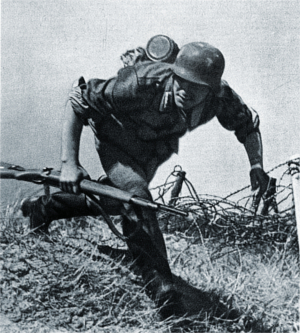
Hitler’s job in the war was all the more dangerous, as [Fascist] school textbooks and other propaganda accounts would recount, because he had to take messages through machine-gun fire from trench to trench, while ordinary front-line soldiers could find some protection from enemy fire inside the trenches. For instance, the 1935 children’s book Die Geschichte von Adolf Hitler den Deutschen Kindern Erzählt (The Story of Adolf Hitler Told for Children) gives an account of young Hitler constantly fighting his way through collapsing trenches, infantry fire, and exploding shells,⁹ concluding:
Hitler was always one of the bravest soldiers in every battle. His comrades at that time later said that they often marvelled that Hitler had not met with a bullet long ago. Because he was so brave and dependable, he was made a dispatch runner. He had to run straight through gunfire and bring news from one officer to another. This was a very dangerous job but Hitler always performed it courageously and quietly. For this, the Kaiser first gave him the Iron Cross Second Class, and after that even the Iron Cross First Class, which only the very bravest soldiers were given.¹⁰
In the same vein, Karl Lippert, the NCO in charge of the regimental dispatch runners, claimed in 1940 that during one of their missions in early 1915 Adolf Hitler, Anton Bachmann, and he himself ‘ran into […] heavy machine-gun fire’ at ‘the street intersection in Messines’.¹¹
Similarly, in 1940, Hitler’s fellow dispatch runner Heinrich Lugauer told the Nazi Party archive, which for propaganda purposes was recording testimony of Hitler’s former comrades: ‘I specifically remember his perpetual readiness for duty in the delivering of dispatches near Fromelles in early 1915. He would regularly take up the more dangerous routes for his married comrades. Actually we shook our heads often enough in disbelief that he managed to return completely unharmed, particularly during the advance on the Marne.’¹²
Ignaz Westenkirchner, one of Hitler’s other fellow dispatch runners, tried to underline how dangerous Hitler’s and his task was by pointing out: ‘Generally two of us were sent out together, each bearing the same dispatches, in case anything happened to either of us.’¹³
Meanwhile, Hans Mend, a cavalry dispatcher in the List Regiment, claimed in the introduction to his quasi-hagiographical account of Hitler’s war years, first published in 1930, that Hitler was ‘brave, fearless, outstanding’.¹⁴
Similar characterizations were provided by Balthasar Brandmayer in the 1930s when he told a heart-warming story about how Hitler volunteered to take over his job for two weeks in addition to his own, so that Brandmayer could visit his family in Germany.¹⁵
Similarly, Max Amann, the Staff Sergeant of regimental HQ, told U.S. interrogators in May 1945: ‘Hitler was courageous and stood up well under strain; even then he showed a passion for war.’¹⁶
[…]
The reality of Hitler’s war existence was rather different. Private Hitler had to alternate between three day shifts at the advance post of regimental HQ inside Fromelles Castle and three day shifts at the regular regimental headquarters in Fournes, where the administrative support of the regiment was based.²⁵
Fournes lay an hour’s walk from Fromelles behind the front. Even though British and French artillery fire had inflicted severe damage on the church, school, and the rest of the village in October 1914²⁶ and even though pre-war guidebooks had warned tourists of the ‘primitive provincial characteristics’ of inns and ‘watering places’ in places like Fourmes,²⁷ Private Hitler’s domicile seemed like heaven to the soldiers of RIR 16. The popular claim that Hitler ‘knew what it meant to live in the mud and the slime of the Western Front’²⁸ is thus quite wrong.
Fridolin Solleder would later recall that life in Fournes was totally different from the life in the trenches: ‘The lovely summer sun in Flanders and the cool breeze that blows from the sea lets the infantrymen—who are staying a good hour away in the quiet quarters behind Fromelles, where French children play “shop” with grenade splinters and play with balls of shrapnel—soon forget the horrors of the trenches.’²⁹
Fournes, which had existed for a millennium, was well past its prime, mostly consisting of long rows of modest brick buildings. Yet the elegant eighteenth-century castle, the bandstand at the centre of the village, as well as the little chapel opposite the bandstand similar to the kind that could be found in every village in Catholic regions of Bavaria gave Fournes a charm and a sense of home and belonging that stood in stark contrast to life in the trenches.
While the chateau housed the HQ of the 12th Reserve Brigade, the regimental HQ of RIR 16 was located in the home of the local public notary, which was one of Fournes’ most elegant houses. Private Hitler and his fellow dispatch runners had been assigned a room in the building attached to the rear of the main building.³⁰
As a dispatch runner for regimental HQ, Hitler’s main task was to take messages to the headquarters of the regiment’s battalions. The job to take messages to the trenches was generally left to dispatch runners of battalions and of companies. This is not to say that he never made it to a trench but this was not normally his job.
The primary danger for Hitler was artillery fire behind the front and not machine-gun and rifle fire or any of the other grave hazards of trench life such as from mines explosions right under German trenches. Karl Lippert’s 1940 claim that Hitler and he had been subject to heavy machine-gun fire at the crossroads in Messines is fictitious. No concerted machine-gun fire could have reached all the way to Messines from the British positions at the bottom of Messines Ridge.³¹
Similarly, Ignaz Westenkirchner’s ‘proof’ of the extraordinary danger of Hitler’s post—namely that two dispatch runners had to be deployed in order to make sure that at least one runner would get the message through—needs to be treated with great caution. In fact, according to Hitler’s superior, Fritz Wiedemann, sending two dispatch runners was standard procedure which due to the shortage of men during the war was rarely followed in the List Regiment.³²
Moreover, Brandmayer’s claim that Hitler took over his duties for a fortnight is bogus. Even if Hitler had volunteered to do so, it would have simply been impossible for him to carry out the duties of two dispatch runners unless he had gone totally without sleep for two weeks.
It is difficult to find anything accurate in the statement from one of the standard Hitler biographies about Hitler’s rescue of the deputy regimental commander at Gheluvelt in late October, according to which, as we have seen, ‘under heavy fire Hitler, now a regimental dispatch carrier, found a medic and the two dragged the deputy [regimental commander] back to the dressing station.’³³
For a start, Hitler was not yet a regimental dispatch carrier when the List Regiment fought at Gheluvelt and thus not attached to regimental HQ. Moreover, the deputy regimental commander—Hitler presumably refers to the regimental adjutant, Lieutenant Philipp Schnitzlein, here, as there was no such rank as a deputy regimental commander—was injured on 31 October in Gheluvelt.³⁴ On that day, however, Hitler’s company spent its time in the relative calm of a former British trench outside of the park of Gheluvelt Castle.³⁵
Hitler was thus not anywhere near Schnitzlein and could not possibly have been in a position to save Schnitzlein ‘under heavy fire’. Furthermore, the portrayal of Hitler as ‘the picture of a front-line fighter’ is more akin to the kind of description [Fascist] propaganda liked to give than to an accurate rendering of the appearance of a dispatch runner. Furthermore, Hitler was not to spend three months in the Battle of the Somme. In fact, as we shall see, Hitler was only to spend four days in that battle.
(Emphasis added. Click here for more.)
Pg. 97:
One might still wonder though, as historians repeatedly have,³⁶ whether the early award of an Iron Cross 2nd Class to Hitler, as well as the award of an Iron Cross 1st Class in 1918, did indeed suggest that Hitler’s job had been exceptionally dangerous and that he had been unusually brave and heroic in his service. It was, we are told, ‘a rare achievement for a corporal’ to receive both Iron Crosses.³⁷
One of the standard Hitler biographies also points out that the new regimental adjutant, Fritz Wiedemann, and the regimental Staff Sergeant, Max Amann, had even proposed Hitler for an Iron Cross 1st Class in November 1914: ‘Wiedemann and Sergeant Amann now had time to make up the decoration list. They recommended Hitler for the Iron Cross, 1st Class, but since he was on the staff put his name at the bottom of the list. For this reason alone Hitler was turned down and instead given a 2nd Class award’.³⁸
This story is little more than fiction, as Wiedemann was still serving with RIR 17 at the time and did not join RIR 16 and become its regimental adjutant until 1915.³⁹ There are good reasons to doubt even the proposition that the award of the Iron Crosses suggests extraordinary bravery on Hitler’s part compared to the rest of the List Regiment.
While certainly an award for bravery, the Iron Cross being awarded to Hitler does not necessarily prove that he was more courageous than most men in the front line. Often the award of an Iron Cross signified rather how well connected soldiers were to regimental headquarters than serving as an absolute measure of a soldier’s bravery.
In other words, Iron Crosses tended to go either directly to officers, such as the Commander of RD 6’s military police unit, Georg Arneth, or to those soldiers who were familiar with the officers who had the privilege to nominate soldiers for awards. It was thus little surprise that the sixty recipients of Iron Crosses on 2 December included the four dispatch runners of regimental HQ.
At the same time, Father Norbert (who himself had been awarded an Iron Cross in mid-November which he proudly wore attached to his monk’s habit) had recorded in the aftermath of the baptism of fire of RD 6 the disappointment many soldiers felt at having not been honoured.⁴⁰
In short, the mere fact that Hitler was assigned to regimental headquarters, rather than his commitment and dedication, increased his chances of receiving an Iron Cross.
I feel the need to tell readers that movements do not lie about their heroes solely to satisfy said heroes’ vainglory or be ideologically consistent, but to maintain morale and establish an inspirational rôle model for others to follow. It may seem that the German Fascists were ashamed that their Führer had a relatively comfortable job in 1915, but that is beside the point. It was useful to the Fascists to create perfect models for others to emulate and convince the public that they bet on the right horse.