

(This takes 5¾ minutes to read.)
The Lärmgerät, or the so-called ‘Jericho trumpet’, is the most recognisable sound from the Second Thirty Years’ War. It is not a byproduct of sheer airplane turbulence, but an actual siren. The media tend to incorrectly associate this sound with any aeroplane that is about to crash-land. The more circumspect media correctly restrict it to the Junkers Ju 87 but tend to inaccurately suggest that it was in use throughout all of World War II, when hearing it in 1942–1945 would have been highly unlikely at best.
Quoting one website:
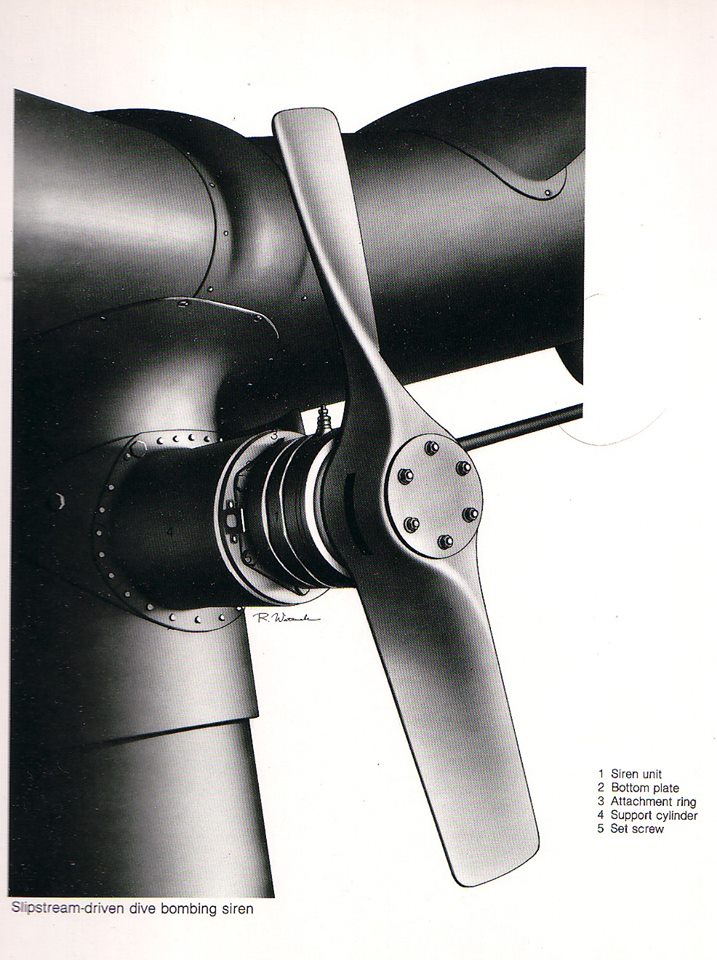
The B-1 was also fitted with ‘Jericho trumpets’, essentially propeller-driven sirens with a diameter of 0.7 m (2.3 ft)[42] mounted on the wing’s leading edge directly forward of the landing gear, or on the front edge of the fixed main gear fairing. This was used to weaken enemy morale and enhance the intimidation of dive-bombing. After the enemy became used to it they were withdrawn. The devices caused a loss of 20–25 km/h (10–20 mph) through drag. Instead, some bombs were fitted with whistles on the fin to produce the noise after release.[43] The trumpets were a suggestion from Generaloberst Ernst Udet (but some authors say the idea originated from Adolf Hitler).[44]

Quoting Yaron Jean’s Hearing Experiences in Germany, 1914–1945: Noises of Modernity, page 215:
Udet, drawing on his vast experience as a pilot in attacking ground targets during the First World War, hoped that these sirens—which could be activated from the cockpit while the plane was making an almost vertical dive toward its target—would prove to be a weapon of exceptional psycho-acoustic effectiveness that would instill fear in its targets and paralyze any resistance on their part. The Stuka’s siren, which used technology to associate the historical symbolism inherent in noise with the aural symbolism of approaching destruction, was given by Udet the symbolic and picturesque name “trumpet of Jericho.”⁵⁷
This was his way of pointing up the historical and symbolic relationship that had existed since primordial times between the overwhelming power of noise and how it was heard in the biblical story, and its modern incarnation in the technologies of the air war. Small wooden propellers mounted on the plane’s wings were spun by the flow of air as it dove, and this produced a bloodcurdling scream, which became for many people one of the acoustical traumas of the Second World War. As one Stuka pilot wrote home, “It must be awful to be underneath it during a dive. Only the Russian soldiers could stand it more than a few times.”⁵⁸
Quoting Brandon Grosch’s ‘The Use of Terror as a Weapon by the Luftwaffe, 1937–1945’:
Lessons learned from the Condor Legion were applied in [Luftwaffe] operations training throughout the Second World War. An inferno rained from the skies over Warsaw, Rotterdam, the Champagne city of Mareuil, Paris, London, Moscow, and London once again between the years of 1939 and 1945.¹³
For most of this period, the sounds of the Junkers Ju-87 Stuka represented the haunting impact of [Luftwaffe] terror bombing. First, the low drone of dozens of piston engines pierced through the peace of a sunny, cloudless day. Next, as the silhouettes of their inverted-gull wings filled the sky over a target city, they suddenly turned and literally screamed into action.
As the dive bombers pushed their noses down into an almost ninety-degree angle, civilians on the ground heard an air-driven siren that started at a low rumble and slowly escalated into an unholy screech followed by earth-shaking explosions as whistling bombs impacted buildings and streets populated by civilians who could not get themselves to shelter in time.¹⁴
The siren, combined with deceptively simplistic cardboard fins attached to the bombshells which created the descending whistle sound popularly associated with all bombs, announced destruction falling terminally towards helpless targets on the ground.
These features, together referred to interchangeably as the “Trumpets of Jericho” by German aircrews, were so iconic that almost every [A]llied propaganda film from the era featured their harpy-like auditory assaults whenever showing a [Luftwaffe] aircraft, regardless of whether or not the plane was actually a Stuka.
The Stuka did not always scream during its hunt, however. The beginning of the Stuka’s technical history does not indicate an operational bias towards terror. Junkers Flugzeug- und Motorenwerke AG (JFM), the production company responsible for the Stuka and other [Axis] bombers, wrote operational manuals, called Betriebsanleitungen, for its aircraft. These users’ manuals were much like those a car company would produce today. The manual for the early-war model of the Stuka, the B-1, featured many diagrams of the aircraft and its various subsections, such as figure 2, informing its pilots and mechanics about the important systems equipped on the aircraft and recommendations on how to get the best performance from the machine in flight.¹⁵
The most important detail, however, was missing from the manual. None of those plans show the siren. No portion of the passages on the Rumpfwerk (fuselage) or Fahrwerk (undercarriage), where the siren was mounted on the Stuka, mentioned the noisemaker itself.¹⁶ A Critical Past video also shows a Stuka attack on a Polish target in 1939. It too features no siren sound.¹⁷
William Green, a late-20th century military aviation historian, documents in an albeit slightly outdated but nevertheless comprehensive reference, the various versions of the Stuka. His diagrams feature the siren on the aircraft and a short description identifying its only purpose as to spread terror among those on the targeted grounds.¹⁸
This thread is common among historians who study the Stuka. No purpose existed for the siren apart from striking fear into the hearts of its targets. In fact, it created additional drag on the airframe, meaning the plane itself performed more poorly with the siren than without. Despite this, the Luftwaffe retained its use until the Stuka’s obsolescence in the mid-war, although the plane itself was never fully retired until the war’s end.
In one Frenchman’s memoir of the war, this view is corroborated as he explicitly cites the Stuka in an attack on his region. In the words of Elie Poulard,
on the morning of Sunday, May 19, it was our turn. I was getting ready to go to Mass when Stukas arrived above Mareuil… these planes were equipped with a siren and their bombs with whistles. All that made such a terrifying noise that it led to some panic in part of the village’s population… The same day, around two o’clock in the afternoon, a new wave of Stukas bombed the whole length of Mareuil.¹⁹
Poulard experienced firsthand the screeching nightmares that were the “Trumpets of Jericho,” shown mounted on some Stukas in figure 3, and he specifically experienced them while never being anywhere near the frontline of combat throughout the war.²⁰
Poulard never served as a soldier. He only mentioned the Stuka at the beginning of the war when he lived as a civilian in a small town with slight industrial capacity. Mareuil could not have been a truly military target for the Luftwaffe. Poulard, his family, and the other French civilians surviving there at the time were the intended casualties of these attacks.
These varied sources from slightly different periods of the war suggest that the siren and whistle combination was not originally included in the design, nor was it implemented on the factory line by Junkers. I find it much more plausible that the “Trumpets of Jericho” were an innovation of the field rather than of the designer’s office and were implemented by dive-bombing Stukageschwader units on an individual basis, probably at the behest of senior Luftwaffe commanders. Nonetheless, popular perspective remembers the Ju-87 as the most iconic weapon of terror in military history despite only about six years of service in the air.
(All emphasis added. Click here for more.)
There is a rumour that the siren’s purpose was more practical:
A former Stuka pilot once told another story:
those sirens where installed for the early pilots to monitor the dive speeds. Constantly looking through your sight makes you unable to read your instruments, thus frequently leading to fatal overspeed situations. This mechanic was soon regarded inefficient but kept nevertheless after one realized how much of a psychological effect it had for ground troops - both own and enemy.
Nevertheless, I have been unable to corroborate this rumor. Perhaps there is some German literature confirming it, but I cannot read German (yet).
These sirens were in use from 1939 to 1941, and were present in the early phase of Operation Barbarossa. However, Axis pilots apparently found this siren too cumbersome; it slowed down their Stukas and spoiled any surprise for the enemy, so they phased it out.
Our enemies have long used noise as a means of breaking our nerves. For byspel, many Confederates had a ‘rebel yell’ that they expressed to intimidate Unionists. More recently, Palestinians have to put up with the unnerving sound of drones hovering above them, and the settlers have repeatedly used recordings of agony to confuse Palestinians into thinking that there are others outside who need their help, drawing them into deadly traps. Do not underestimate the power of noise in warfare.