[

](https://substackcdn.com/image/fetch/$s_!xYAJ!,f_auto,q_auto:good,fl_progressive:steep/https%3A%2F%2Fsubstack-post-media.s3.amazonaws.com%2Fpublic%2Fimages%2Fee85e16d-7636-46d7-9bd2-a029d3dda18c_7057x4126.jpeg)
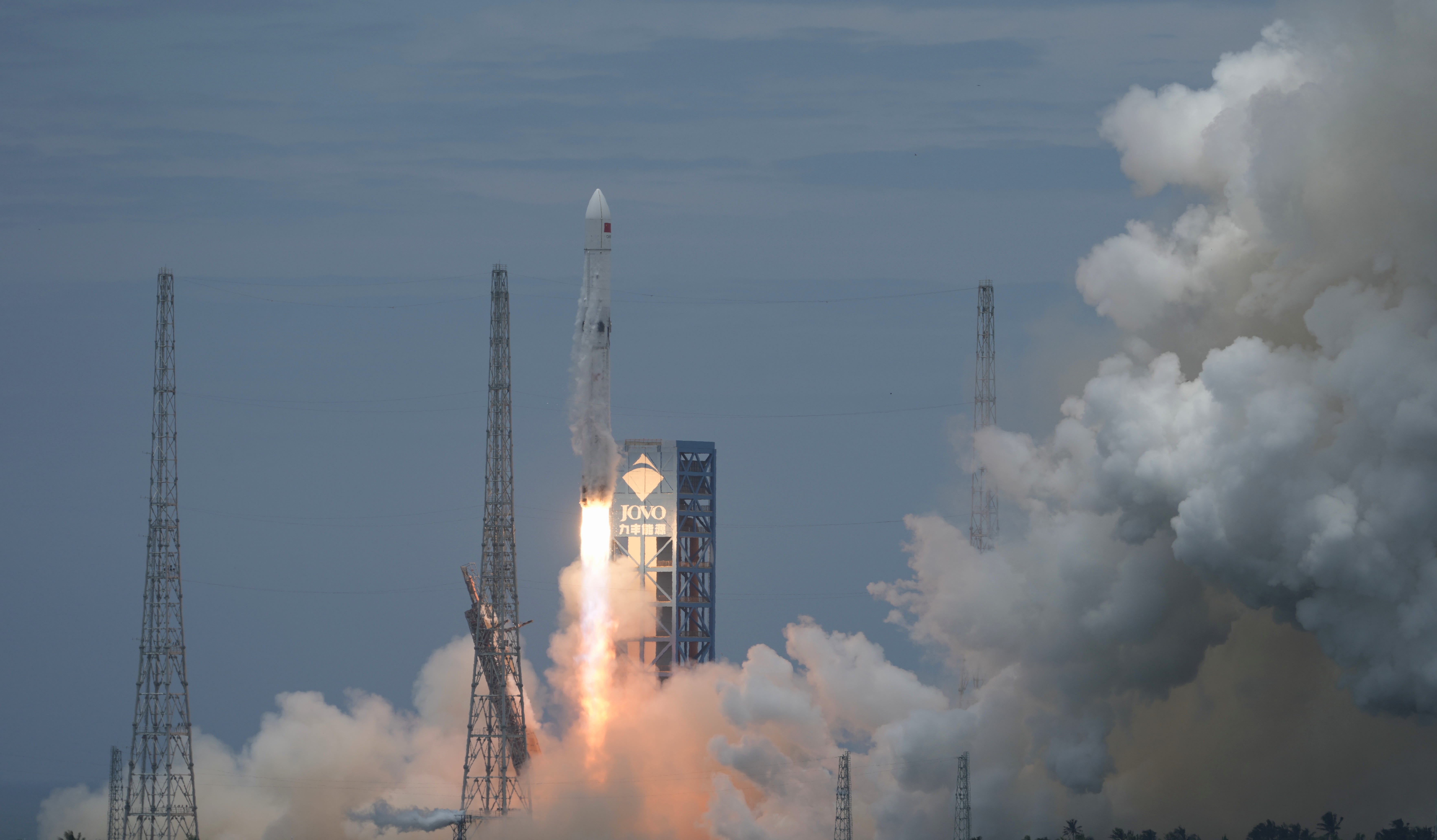
The Long March 10B Y1 vehicle lifting off from the Wenchang Commercial Space Launch Site on July 10th 2026. | Image: China Aerospace Science and Technology Corporation
For the first time, the Long March 10B blasted off from Commercial Launch Pad 2 at the Wenchang Commercial Space Launch Site at 12:15 pm China Standard Time (04:15 Universal Coordinated Time) on July 10th, heading for an 800-kilometer low Earth orbit as part of a demonstrative flight.
Ascent away from the launch site was as expected, with the seven YF-100K engines providing the thrust needed. Those burned for about two and a half minutes before shutting down for state separation, after which the second-stage’s YF-219 ignited to continue flight into orbit, which was achieved not long after. China Satellite Network Group (中国卫星网络集团有限公司) was shared to have been the customer to deliver an experimental satellite designated ‘CX-26’, possibly related to GuoWang (国网).
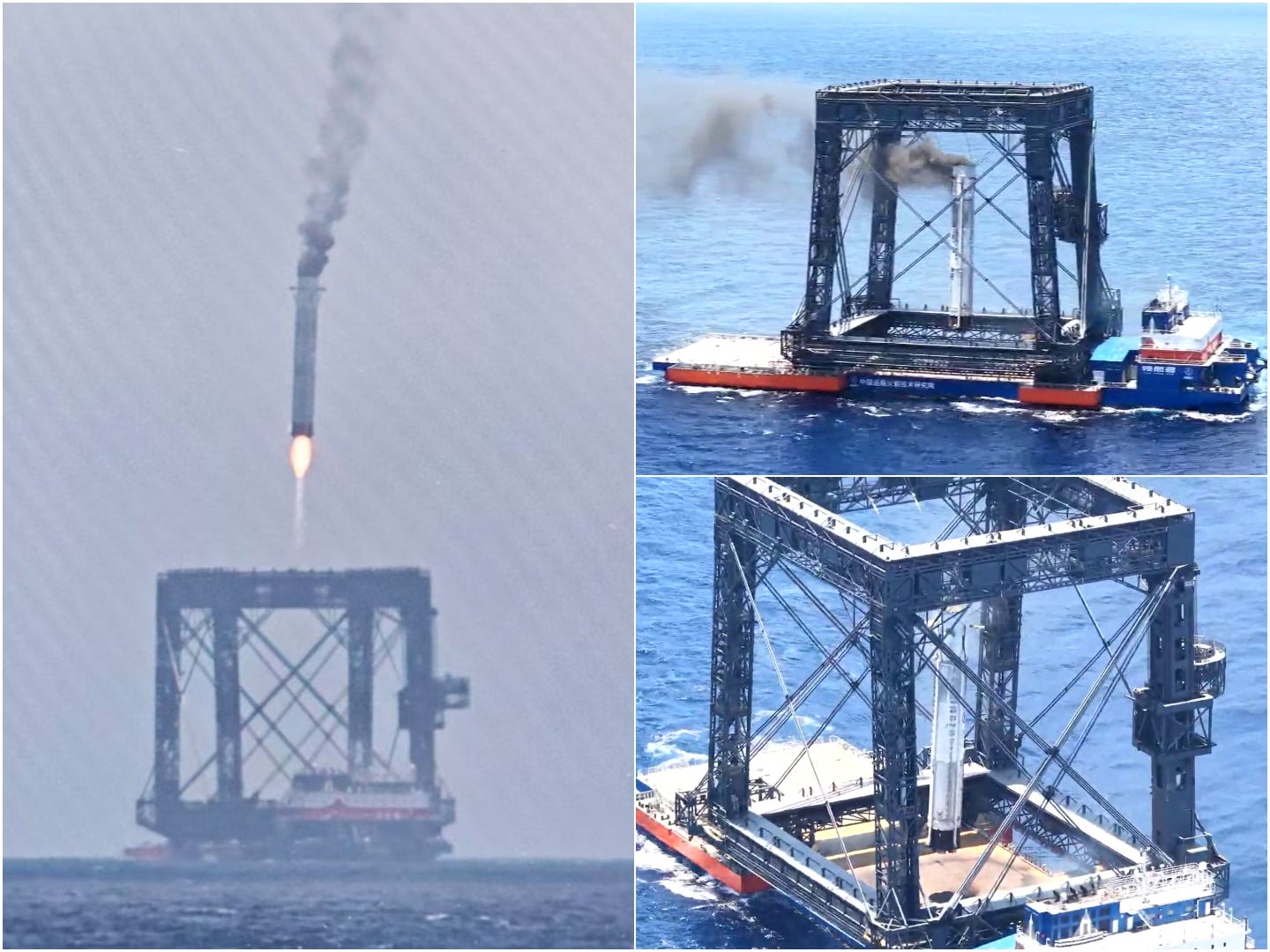
Having completed its part of supporting orbital launch, the first-stage booster started to fall back to Earth in a controlled manner, aiming for the recovery drone ship ‘Linghangzhe (领航者)’. Part of that had an atmospheric reentry burn to protect the booster from succumbing to intense thermal stress, where three YF-100K engines ignited briefly, with the added benefit of refining the descent path.
After almost ten minutes of flight, the Long March 10B’s first-stage booster ignited three YF-100K’s for the last time, then swapped to one to slow and position itself onto the tensioned steel wires of ‘Linghangzhe’, where it was successfully caught! That catch took place 430 kilometers downrange and makes the launch vehicle China’s first proven reusable rocket1.
[

](https://substackcdn.com/image/fetch/$s_!7G1s!,f_auto,q_auto:good,fl_progressive:steep/https%3A%2F%2Fsubstack-post-media.s3.amazonaws.com%2Fpublic%2Fimages%2F91e0b251-310a-441c-9c9f-973addb17505_1440x1080.png)
The Long March 10B Y1 vehicle’s first-stage performing its catch burn (left) and caught onboard ‘Linghangzhe’ (right). | Image: China Aerospace Science and Technology Corporation
In a post-flight blog post, the China Academy of Launch Vehicle Technology, who manufacture the Long March 10B, shared that its first flight verified its choices for autogenous second-stage pressurization alongside the first-stage’s ability to start its engines multiple times, handle high aerodynamic and thermal stresses, descent to a target location with precision, as well as its recovery scheme. This launch also verified first-stage systems for the Long March 10A, which is shared with the Long March 10B minus system to make it human-rated, according to Rong Yi (容易), an Expert Rocket Designer leading development of the Long March 10 series, while she spoke with the media shortly after launch. The Long March 10A is expected to fly at least once before the year’s end too.
For Hainan International Commercial Aerospace Launch Co Ltd (海南国际商业航天发射有限公司), operator of the launch site, they committed to and accelerated their implementation of liquid methane propellant systems to enable the debut flight, meeting requirements to be loaded with propellant in under four and a half hours. Additionally, the operator dedicated its Commercial Launch Pad 2 teams to preparing for the Long March 10B, allowing for issues that arose, like hydraulic piston failures, to be resolved in a few weeks.
[

](https://substackcdn.com/image/fetch/$s_!UU7m!,f_auto,q_auto:good,fl_progressive:steep/https%3A%2F%2Fsubstack-post-media.s3.amazonaws.com%2Fpublic%2Fimages%2F1cd23c21-2da7-41d9-ba66-59ec948f8813_2390x1190.png)
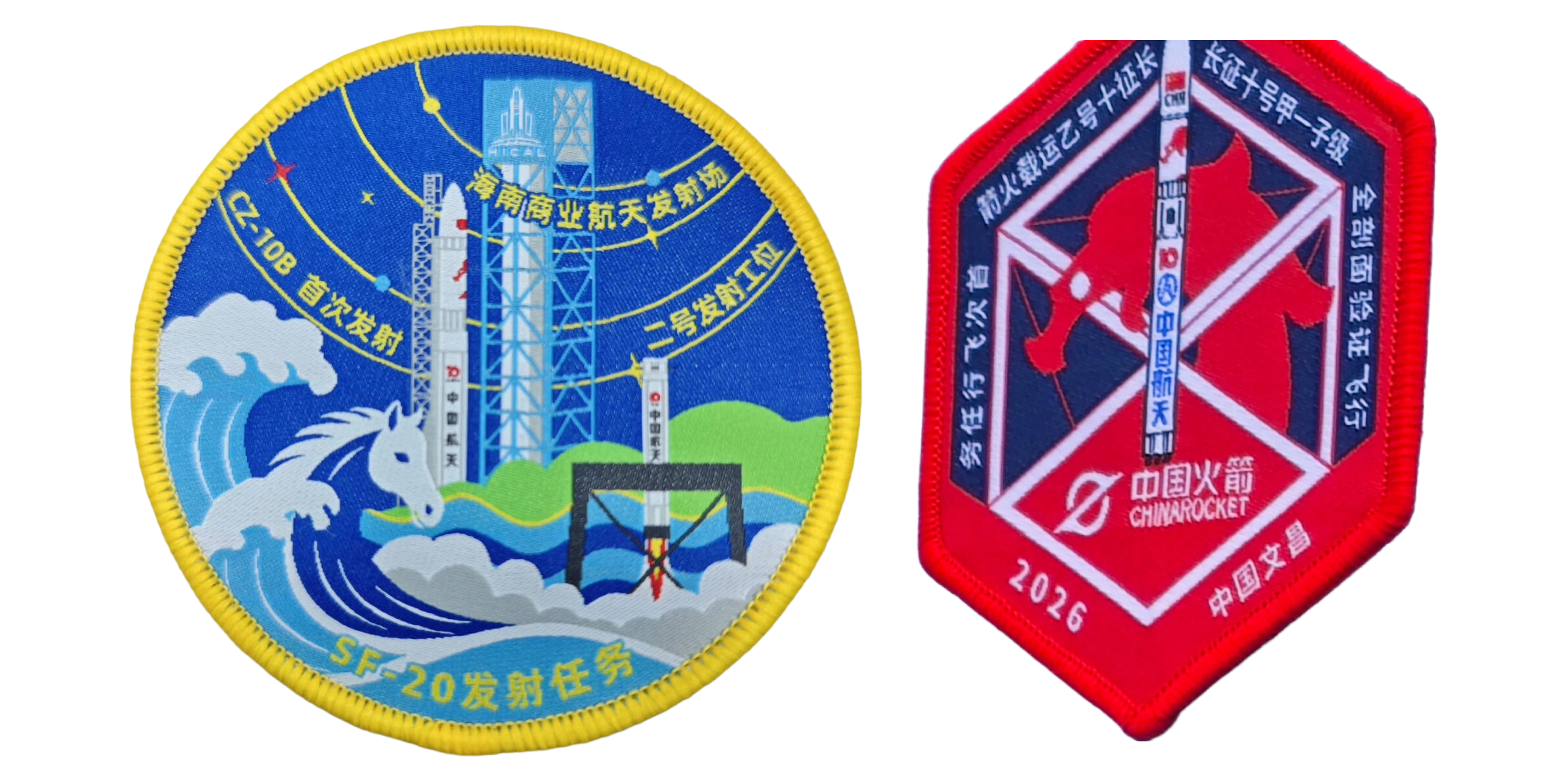
Physical patches given to launch site staff (left) and the Long March 10B Y1 team (right). | Image: Hainan International Commercial Aerospace Launch Co Ltd / China Long March Rocket Co Ltd
Getting the Long March 10B to fly from the commercial launch site has been a multi-month process, with support hardware being assembled at the start of the year before an inaugural April rollout. April saw the completion of a wet dress rehearsal of the countdown to test the launch vehicle and upgraded site systems, skipping static fires as those were completed elsewhere. The flight was then delayed for a few weeks to replace faulty launch pad components.
With the confidence gained from this flight and a February systems verification, the China Aerospace Science and Technology Corporation says that the next Long March 10B is planned to fly before the end of the year. That will also have a reusable first-stage, either using a new booster or the one from today after its return to land for inspections and refurbishment.
Today’s mission was the 1st for the Long March 10B vehicle, the 1st flight of the Long March 10 series, and the 657th launch of the Long March launch vehicle series. This was also the 48th launch from China in 2026.
Liftoff and catch footage via 海南商发 and 商业航天发展 on WeChat, 中国的航天 and China航天 on Weibo, and raz_liu on Twitter.
Launch livestream via International Rocket Launches on YouTube.
This section is for those less familiar with China’s Long March series of launch vehicles.
As a commercially focused launch vehicle marketed by China Long March Rocket Co Ltd (中国长征火箭有限公司), the Long March 10B is a two-stage partially reusable rocket fuelled by rocket-grade kerosene and liquid oxygen in its first-stage, with a liquid methane and liquid oxygen utilizing second-stage. It is based on the Long March 10 series from the China Academy of Launch Vehicle Technology, but omits additional systems required for redundancy and safety, as it does not carry human passengers.
Currently, the Long March 10B is expected to be able to lift the following:
-
16,000 kilograms to a 200-kilometer orbit with booster reuse
-
11,000 kilograms to a 900-kilometer orbit with booster reuse
[

](https://substackcdn.com/image/fetch/$s_!bs29!,f_auto,q_auto:good,fl_progressive:steep/https%3A%2F%2Fsubstack-post-media.s3.amazonaws.com%2Fpublic%2Fimages%2Feeb82ec2-f198-41a3-a9d9-51a91e9d74fc_1280x1598.jpeg)
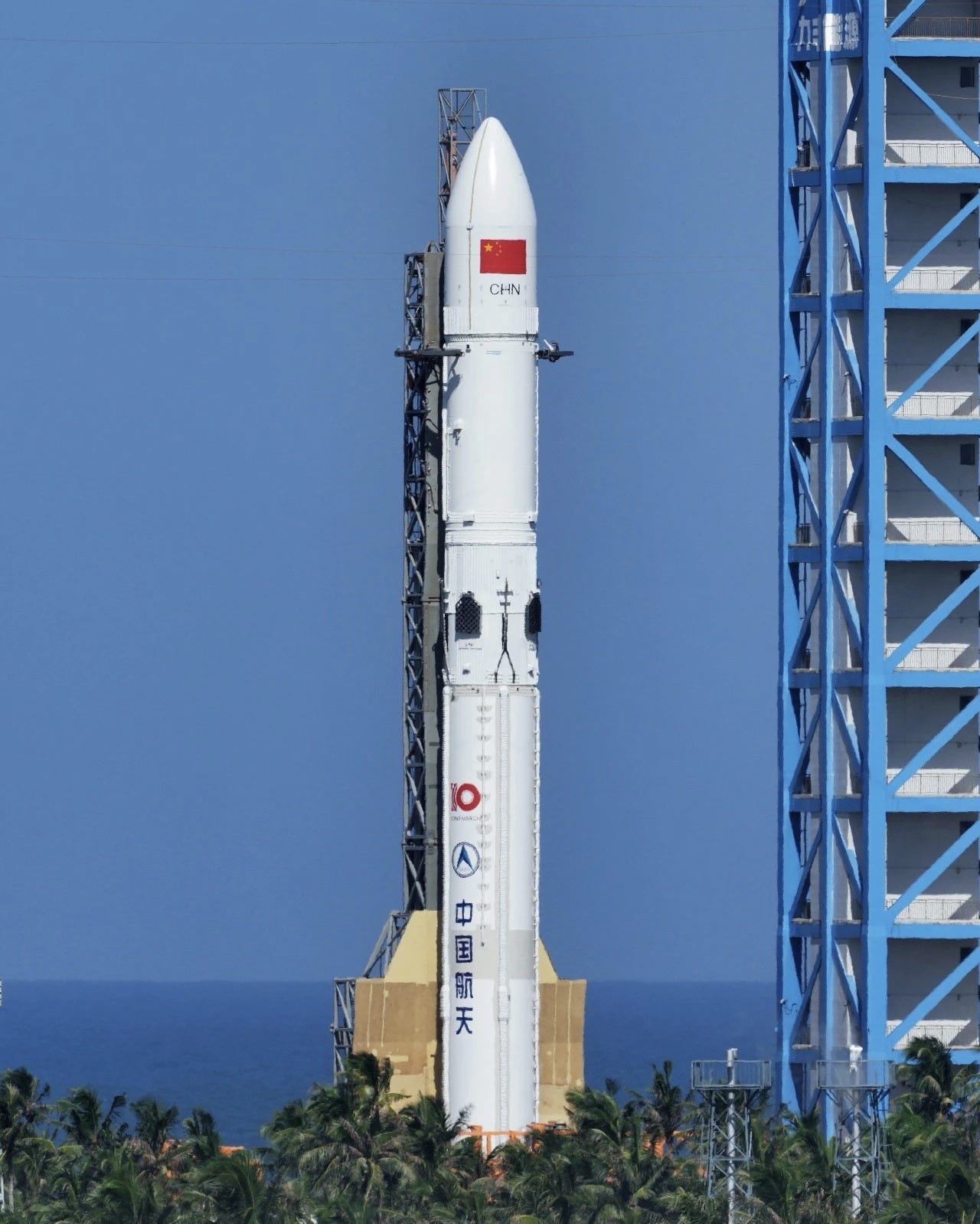
The Long March 10B Y1 vehicle stood at Commercial Launch Pad 2 in the hours before its debut flight on July 10th 2026. | Image: China Aerospace Science and Technology Corporation
Enabling ascent out of the atmosphere are seven YF-100K engines, producing 892 tons of thrust, on the first-stage. Continuing flight into orbit is a single YF-219 engine, generating 140 tons of thrust, powering the second-stage.
To facilitate reuse of the first-stage booster, the Long March 10B relights three engines during atmospheric re-entry and then again to shed most of its speed, before swapping down to one engine for fine-tuning of a catch and hovering. Four metal hooks at the top of the first-stage enable a catch by hanging onto tensioned steel wires, moved into position by the recovery drone ship. Four grid fins next to the hooks control the booster during unpowered descent.
Both stages of the Long March 10B are 5 meters in diameter, while the full launch vehicle stands 70.2 meters tall with its long fairing or 63.6 meters tall with its short fairing. Available fairings for it are also 5 meters in diameter. When fully fuelled, the launch vehicle weighs 760,000 kilograms.
So far, the Long March 10B has flown from the Wenchang Commercial Space Launch Site, on the east coast of Hainan province, and is recovered at sea on the autonomous Long March 10 series booster-catching ship ‘Linghangzhe (领航者)’.


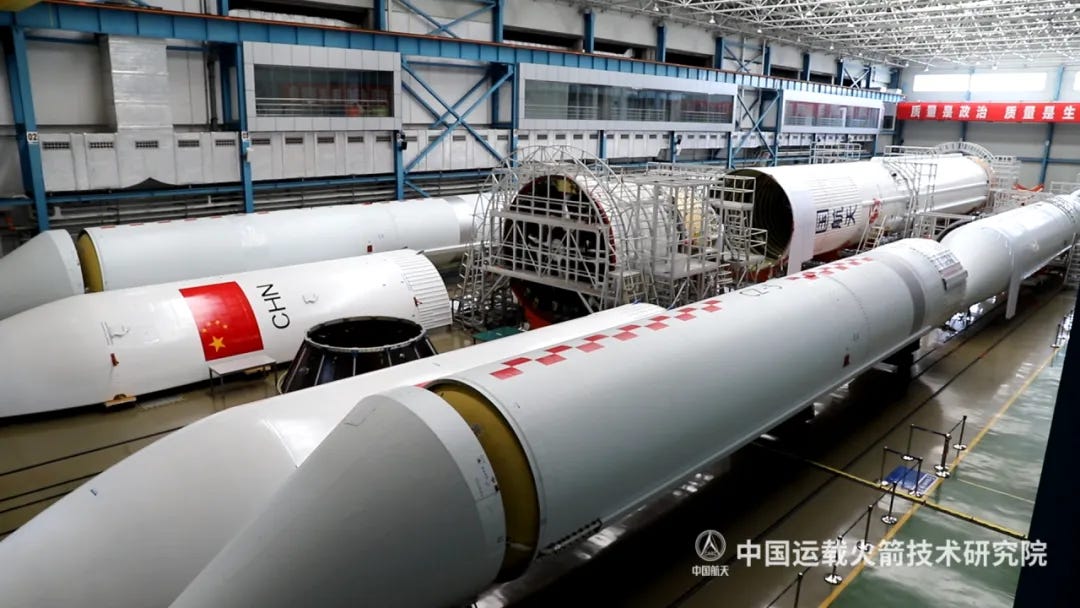
The Long March 10B Y1 vehicle being transported to Commercial Launch Pad 2 in April 2026. | Image: Hainan International Commercial Aerospace Launch Co Ltd
Thanks for reading China in Space! This post is public so feel free to share it.
Share
1
Previously, LandSpace attempted to perform China’s first launch vehicle booster landing with the debut flight of Zhuque-3, coming within seconds of doing so in December 2025. The Shanghai Academy of Spaceflight Technology then followed weeks later with the inaugural Long March 12A mission, but failing not long after atmospheric reentry. It has also flown the Long March 12B to trial select first-stage recovery systems.
Meanwhile, CAS Space has brought its Kinetica-2 into orbit, ahead of it becoming reusable around 2028, and Space Pioneer has attempted to fly Tianlong-3 before making it a partially reusable rocket in a few flights.